Pages

Showing posts with label motivation. Show all posts

Monday, 2 December 2024

Herzberg's theory of motivation hygiene

Ah: what a blast from the past this is! Herzberg's theory of Motivation Hygiene or the "Two Factor Theory" (1966). Herzberg himself called the theory "motivation-hygiene", an concept which sprang from his research into mental health (Miner, 2005).

We are used to thinking in pairs: health/illness; mental health/mental illness, like they are two sides of the same thing. Herzberg's idea was that these two pairs might be distinct ideas or processes; not continua; nor toggles. He wondered if the job satisfaction and dissatisfaction might be a similar decoupled thing: two discrete ideas, not a toggle (Miner, 2005). So he researched how we feel about our work, and came up with a list of things contributing to work satisfaction (i.e. motivation factors), and a second, separate list of contributors leading to dissatisfaction (i.e. hygiene factors) (Miner, 2005).

Hygiene factors are "the presence or absence of job dissatisfiers, such as working conditions, pay, company policies, and interpersonal relationships. When hygiene factors are poor, work is dissatisfying" (Daft, 2008, p. 231). Examples of things which turn us off our work might include: a tangle of red tape such as company policies and administration; overly bureaucratic working conditions; poor interpersonal relations; low salary; a job that is low status; poor security; low trust; being micro-managed; or onerous supervision. These are things that we need to consider when we going to change roles: we may be jumping from the frying pan into the fire.

Motivating factors meet our "high-level needs such as needs for achievement, recognition, responsibility, and opportunity for growth. Herzberg believed that when motivators are present, workers are highly motivated and satisfied" (Daft, 2008, p. 231). Examples of motivators are likely to include: personal achievement; interesting or rewarding work; a sense of responsibility; opportunities for growth and development; the satisfaction of a job well-done; recognition; advancement; recognition of our peers. These are things we consider when we are in the job, or the things we need to think about with our development.

What was really interesting was that Herzberg thought we should organise HR into a Hygiene division to deliver all the tasks and a Motivation division which dealt with all the motivation factors (Miner, 2005). In many ways, this is the difference between HRM and HRD: HRD looks at job design, seeks competencies, provides feedback, organises training, develops culture, and grows employees. Good spotting, Mr Herzberg!

However, we need to remember that both satisfaction and dissatisfaction can exist together. Criticisms of the model are that it is quite method-bound, and that the separation of the satisfaction & dissatisfaction dimensions is arbitrary; they can both occur simultaneously in our work.


Sam

References:

Daft, R. L. (2008). The Leadership Experience. Cengage.

Herzberg, F. (1966). Work and the Nature of Man. World Publishing Company.

Miner, J. B. (2005). Chapter 5: Motivation-Hygiene Theory Frederick Herzberg. In Organizational Behavior 1: Essential theories of motivation and leadership (pp. 61-93). Routledge.

read more "Herzberg's theory of motivation hygiene"

Friday, 16 September 2022

Mindset and the mind-body connection

Mindset can be defined as an “implicit theor[y] of intelligence [which] distinguishes people who believe intelligence is unchangeable (i.e., those who have a fixed mind-set) from people who believe intelligence is malleable and can be developed through learning (i.e., those who have a growth mind-set)” (Moser et al., 2011, p. 1484). Further, a “growth mindset is based on the belief that [...]our basic qualities are things [we] can cultivate through [...]our efforts” (Dweck, 2006, p. 7), and our mindset changes “what [we] strive for and what [we] see as success” (p. 12).

What is really interesting is that now mindset is being explored in many more and varied ways than I expected to see on first reading Carol Dweck's book in the mid-noughties. Roll the clock forward almost twenty years, and it is now being proposed that we can "harness [this] mind-body connection", with our mindset enabling us to improve our lives (RNZ, 2022). This works for anti-ageing, for weight loss, for exercise, and for pain management.

From a book on the topic written this year by David Robson (RNZ, 2022), I found the following mindset example, on diet, very interesting:

“Some neuroscientists say the reality we experience is this kind of controlled hallucination because about 90 percent is created from within and then 10 percent of what we’re experiencing is coming from that data hitting our senses.”

For example, our mindset on dieting can also determine how we read the signals from our gut, affect how hungry we feel, and change our hormonal hunger response, he says.

“When we’re on a diet we often ignore every element of what we’re eating apart from the calorie count and we focus so much on the number of calories that we’re missing out.

“This creates this mindset of scarcity, you know, you’re telling your brain that actually you’re going to be really depleted in the important nutrients and energy that you need to get through the day and then that has a physiological effect on the body.”

That’s why cultivating an indulgent attitude to food can help you lose weight, he says.

“If you’re expecting food to have fewer calories, you see higher levels of that crucial hormone [ghrelin] after eating so your body is still expressing the hormone that’s telling it to seek new food because you’ve got this mindset of scarcity.

“What we want to do is to avoid the mindset of scarcity and the best way to do that is to actually stop focusing so heavily on what you’re missing out on your food … so you really want to focus even more than when you weren’t dieting on things like the flavours and textures and making sure they feel really satisfying for you.”

I know people have said we can think ourselves well, but the science appears to be telling us that this aphorism has some truth in it. It will be interesting to see how the science shapes up.


Sam

References:

Dweck, C. (2006). Mindset: The New Psychology of Success. Baltimore Books.

Moser, J. S., Schroder, H. S.; Heeter, C., Moran, T. P. & Lee, Y. (2011). Mind Your Errors: Evidence for a Neural Mechanism Linking Growth Mind-Set to Adaptive Posterror Adjustments. Psychological Science, 2(12), 1484-1489. https://doi.org/10.1177/0956797611419520

RNZ. (1 May 2022). How your mindset can change your world. Radio New Zealand. https://www.rnz.co.nz/national/programmes/sunday/audio/2018840130/how-your-mindset-can-change-your-world

read more "Mindset and the mind-body connection"

Monday, 11 July 2022

Body doubling

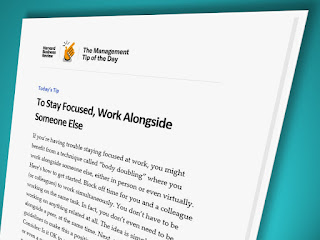
Earlier this year there was a great post in Harvard's 'Management Tip of the Day' series more or less reiterating what I have found over the years which motivates me. When we are having difficulty in keeping our attention on the tasks we are meant to be tackling, we can all benefit from a technique which is called “body doubling” (Harvard Business Review, 2022, citing Grayson Riegel, 2022). This is where we "work alongside someone else, either in person or even virtually" (Harvard Business Review, 2022).

How does this work? Well it turns out that we don’t "need to be working on anything related", or on similar tasks. It is simply about buddying-up to do the mahi, together, and we encourage each other to persevere, together. We get work done in company. Most of us like company (Harvard Business Review, 2022), and the company keeps us engaged much longer than we may do on our own.

To begin working like this, we just need to find time in your calendar where we can work with others, and think about who we might like to work with. Someone with the same type of habits as ourselves is best - if we like to rock along with music, find someone else who likes that too. If we like it quiet, ditto (Harvard Business Review, 2022).

We approach our chosen buddy - or buddies - and juggle calendars to give this a try. Before we have our first session, through, we set some ground rules. We need to think about (Harvard Business Review, 2022):

  • What do we "each intend to accomplish" in this session?
  • How do we "hope to feel by the end of [our] time" together?
  • "Is it OK to ask one another for advice, help, resources, or even a pep-talk if needed?"
  • Can we "mention when [we] notice [...]our peer [is] losing focus?"
  • "When will [we take our] breaks?"
  • "Are [we] working silently or is polite chatting permitted?"
When we finished each session, we should briefly reflect on what we got done, asking the four great questions: what went well, what can be improved, what surprised us, and what was missing. And we are supposed to "thank each other for being present, and decide if and when to do this again" which is a bit icky, but hey (Harvard Business Review, 2022).


Sam

References:

Harvard Business Review (11 March 2022). Management Tip of the Day: To Stay Focused, Work Alongside Someone Else [email]. https://hbr.org/?utm_medium=email&utm_source=newsletter_daily&utm_campaign=mtod_notactsubs&deliveryName=DM181024

read more "Body doubling"

Wednesday, 14 August 2019

Issues with unlimited leave

Unlimited holidays. It sounds great, doesn't it? In the 1990s, some small technology start-ups offered unlimited holidays as a recruitment tool, which was then picked up by some of the multi-national companies such as IBM. The concept probably got the most airplay when Virgin adopted it for their management team in 2014: not all staff, just the management team.

The idea is that staff take time off whenever they feel the need for a break. The management and timing of their own workload is up to them: they are grown ups and can work out when they need to be present and meet their own deadlines.

So what are the ramifications of this idea? One unexpected issue is that staff worry about being visible in taking 'too much' time off, or being uncertain how much time is 'too much'. As a result they end up taking less time off than they should (Spicer, 5 June 2018), because leave is not transparent within the organisation. Unlimited leave also becomes an issue when you leave a workplace: how much leave do you get paid out if you don't get an allocation to begin with (Bayern, 18 June 2019)? And, if HR stop monitoring it - which they usually do, because why go to the cost of counting it unless you need to use it - an organisational 'health' metric disappears.

A solution to all of this is to leave a minimum leave per annum in place (Imber, 26 July 2018), and check that all staff take at least that amount of leave each year. Then there is a clear pay out to make if you leave the organisation before taking your annual allocation each year, the organisational metric still means something, and staff know that holiday is truly considered to be important within the organisation.

The most interesting thing is that when staff take at least four weeks leave a year, then the sick leave appears to drop to almost nothing -at least in the experience of Australian consultancy firm, Inventium. Now there's an indicator of organisational health (Imber, 26 July 2018).


Sam

References:

read more "Issues with unlimited leave"

Monday, 23 September 2013

Three Awesome Job Interview Questions

What if there were three simple questions that you could ask over and over to get to the core of someone's work ethic, motivation and values? Would you ask them when you were interviewing someone?

By crikey, I bet you would. I know I would. However, usually when you read promises like that, they don't deliver. It is like following the 'one weird tip' to lose 500kgs in two minutes: all talk and no trousers.

So when I followed a LinkedIn post link promising just that, I wasn't hopeful. However, I was wrong. John Younger, founder of US cloud recruiting firm Accolo, has indeed created a formula of three questions that work to give you real insight into an applicant's reasons for their actions. The questions are:
  1. How did you find out about the job?
  2. What did you like about the job before you started?
  3. Why did you leave?
In one fell swoop you find out how good the candidate is at networking, how accurate their foresight is and what makes them disconnect. You find out whether they use referrals, if they listen to their instincts, how they tackle problems and how well they know themselves.

Pretty powerful stuff.

Sam
read more "Three Awesome Job Interview Questions "

Friday, 4 November 2011

Newsletter Issue 209, November 2011


Sam Young Newsletter

Issue 209, November 2011
Hi guys,
Are you motivating your staff? Check out Motivation - Intrinsic vs Extrinsic Factors  below.
We have a bit of a laugh with Peta Mathias in Motivational Cooking Advice
Don't forget, if you want to be taken off my mailing list, click here to send me a reply e-mail and I will remove your name.

Motivation - Intrinsic vs Extrinsic Factors

What motivates you?
I know for me, it is personal satisfaction from a job well done. For others it will be recognition. For some it will be challenge. For a few it will be status. For a very few, it will be money.
Richard Daft, in his book "The Leadership Experience" defines motivation as the "forces, either internal or external to a person, which arouse enthusiasm and persistence to pursue a certain course of action” (2005, p. 294). So what does that mean to a each of us?
At its most simple, motivation starts with a need that creates within us a desire to fulfil it; like friendship, food or recognition. So then we have to take action. We behave in a way results in us fulfilling our needs. So we get the rewards that we were after; and we have satisfied our needs.
However, our rewards can be either intrinsic or extrinsic. Intrinsic needs are those things that come from within; personal development, challenge, self-fulfilment, that warm fuzzy feeling of being appreciated, self-determination. Extrinsic needs come from without; recognition, status, promotions and bonuses. Recognition is an interesting factor. It impacts on both extrinsic and intrinsic motivation.
Charles Handy, in his book "Understanding Organizations" (1993), thinks that we that motivation theories can be categorised under one of three headings. Firstly there are satisfaction theories, which assume that a ‘satisfied worker is a productive worker’. Secondly there are incentive theories, which assume reinforcement is the key (this is a ‘carrot’ approach - that reward will lead to good performance - extrinsic motivation). Thirdly there are intrinsic theories, which assume individuals will work harder if they have a worthwhile job – that reward will come from satisfaction in the work itself.
However, Harold Levinson, in his manager’s views of motivation theory (1972) thought that we had a much more complicated approach to motivation. He proposed that we have four main groups, and one that is a combination of any or all of the four. They are:
  1. Rational-economic assumption – we are motivated by economic needs, passive & can be controlled by the organisation. This manager believes in extrinsic motivators (money, status)
  2. Social assumption – we are motivated by social needs, affiliation (teams; social activities)
  3. Self-actualising assumption – motivated by intrinsic needs – autonomy / goal setting rather than managerial control (goals; empowerment)
  4. Psychological assumption – work is part of our identity, our ‘ego ideal’. We need opportunities to fulfil our ‘ego ideal’
  5. Complex assumption – motivated by a combination of dynamic & ever-changing factors
There are lots of theories about how we tap into intrinsic and extrinsic motivation, but one common idea is that if someone is intrinsically motivated, that motivation lasts MUCH longer than if we try to motivate the same person extrinsically (with external rewards).
"That sounds all very good in theory,"  I can almost hear you say "but I bet people aren't really like that in the real world".
However, a recent Employee Insights survey of Kiwi workers shows that 33% of respondents say that "acknowledgement and appreciation" is what motivates them,  32% are motivated by role challenge, 23% by workmates and/or company culture, with 12% rating the dollars as a motivator.
Consultants Robert Walters NZ ran this survey for the second time this year, surveying accounting, finance, banking, management, HR, IT, procurement, supply chain, sales, marketing, secretarial and business support employees.
This means that if you are wanting to reward your staff, you need to tell them you appreciate them; that they provide value. You need to challenge them in a way that they can acheive. You need to have a healthy organisational culture and build a good team atmosphere.
It's not definitely not rocket science, is it :-)
 
References:
Daft, Richard L. (2005). The Leadership Experience (3rd Edition). USA: Thomson South-Western.
Handy, Charles (1993). Understanding Organizations. UK: Penguin
Levinson, Harold (1972) based on Schein, Edgar (1970). Organizational psychology. USA: Prentice Hall

Motivational Cooking Advice

Following on this issue's motivation theme, while laying a thick layer of newspapers in the bottom of a raised herb garden as weed matting, I noticed an unread Dominion Post Magazine from October 22. Peta Mathias had given her usual tongue-in-cheek advice to a reader who wanted to know how he could make some 'fast food' (ie, food he could prepare quickly) as often neither he nor his girlfriend could be bothered cooking.
I felt that Peta's reply was amusing enough to share with you all.
"The secret to fast food at home is to have lots of ingredients already in the kitchen - like peas, fish and pesto in the freezer; tinned tuna, sardines and ready-made curry pastes in the pantry; salami, butter and parmesan cheese in the fridge. If you've got dried pasta, olive oil and red wine, you've got a meal.
"Here's what you do: first drink a glass of wine while you're getting the other ingredients together. Next, look at the pasta and decide you can't be bothered cooking it. Next, take the olive oil, spread it all over your girlfriend, then lick it all off again. This is a very nutritious meal, satisfies two people and you will never complain about being unmotivated again."

Reference: Mathias, Peta (22 October 2011). Your Weekend Magazine. NZ: Dominion Post (p. 5)


How to Hyphenate Words

The Oxford English Dictionary's October newsletter contained a useful little 'how to' on the rules for hyphenation.
  1. We DON'T link 'phrasal verbs' using a hyphen. Phrasal verbs are verbs made up of a main verb together with an adverb or a preposition (or both). The meaning is usually not obvious from the individual meanings of the words. For example "I made up my tie "; 'made' and 'up' forms the phrasal verb.
  2. However, we DO link nouns that are made up of phrasal verbs. You would buy a 'made-up' tie.
  3. We also use hyphens when they clarify our meaning. For example: "There will be extra trains, including more late-night trains" makes sense, whereas "There will be extra trains, including more late night trains" could mean that the night trains were simply late.
So just ask yourself; is this a noun that I am hyphenating? And does it clarify sentence meaning? ... and if in doubt, leave it out :-)


TLAs for SMEs

Here are this newsletter's TLAs (Three Letter Acronyms) for you:
  • UNA, Use No Acronyms. I thought that was cute!

Please feel free to email me with any TLAs that you want to get the bottom (meaning!) of.

Tips, Short+Hot Keys
In this newsletter, we look at all you can do in Publisher with Page commands:
  • Publisher "Move down within a page or scroll down in the Help pane" Page Down
  • Publisher "Move up within a page or Scroll up in the Help pane" Page Up
  • Publisher "Scroll to the left" Ctrl & Page Up
  • Publisher "Scroll to the right" Ctrl & Page Down

Hot Linx
While we assume that creating the right kind of atmosphere at work should be common sense, we often don't act like we understand what common sense is. Check what is productive at http://www.stuff.co.nz/business/industries/5847549/Creating-a-productive-workplace
Read this HBR article on four ways women unintentionally sabotage their career prospects - overly modest, not asking, fitting in, keeping quiet - is fascinating at http://blogs.hbr.org/cs/2011/10/four_ways_women_stunt_their_careers.html?utm_source=twitterfeed&utm_medium=twitter
Check out what Sir Paul Callaghan has to say in a 20 minute speech entitled "StrategyNZ: Mapping our Future" that was delivered in March 2011 at http://www.youtube.com/watch?v=OhCAyIllnXY
Kelly Eggers of the Wall Street Journal looks at the ten worst mistakes made by Uni graduates when looking for their first professional position in this article at http://www.fins.com/Finance/Articles/SBB0001424052970204226204576601420036627098/The-10-Worst-Mistakes-of-First-Time-Job-Hunters

                                Catch you again soon!! E-mail your suggestions to me here
read more "Newsletter Issue 209, November 2011"

Friday, 25 September 2009

Newsletter Issue 172, September 2009


Sam Young Newsletter


Issue 172, September 2009

Hi guys,

To find out what motivates others, the only way you can find out is to Ask & You Will Find Out below.

Read a preview about Nikon's Coolpix - a new camera with a built-in projector.


Don't forget, if you want to be taken off my mailing list, click here to send me a reply e-mail and I will remove your name.


Ask & You Will Find Out


How many of us assume that we know what is in people's heads? We think we either know or can work out what motivates people just by looking at the outside of a person. We can be quite complacent about doing that to others, while, if we stopped to think about it, we would feel grossly insulted by someone doing that to us.

Yet in business we are in constantly danger of 'assuming' what motivates others, when the only way we can truly know is to have open and honest dialogue.

In his newsletter this week, Kenn Butler referred to an old blog page at http://speakingofchange.blogspot.com/2006_05_01_archive.html from 11 May 2006. Written by Psychologist Carol Kinsey Goman, Carol has once again generously allowed me to share her wisdom with you all.

Bill Toppeta, president of MetLife International, told the Fordham Leadership Forum, “What you need to know as the leader is what motivates your people, not what motivates you.”

To bring this philosophy into reality, here is the simple, yet revealing exercise Toppeta uses: He hands out a questionnaire to managers and their direct reports. The manager ranks the items on the page in the order of what she believes most and least stirs her direct reports’ passions. At the same time, the direct report also ranks the items on the list. The lists are compared and then dialogue ensues.

Toppeta says that, for the most part, managers do horribly on this exercise. They think they know what their people are passionate about, but they don’t.

But, of course, that is the point. And as the ensuing dialogues take place, people get to know each other as people, not simply as functions that help the department make its numbers every quarter. And best of all, it is the very essence of employee engagement. Individuals in the workforce have a voice in where they can best make their personal contribution to the company.

And talk about a “win-win” situation. The outcome of marrying personal passions to organizational goals breeds deeper job satisfaction for employees and more profits for the company.

Oh - and when you ask, like Bill, you then have to listen... another key skill that we human beings aren't necessarily that good at!

Interestingly, Bill does listen. The results of questionnaire that Bill uses at MetLife, the annual Employee Benefits Trends Study, has been conducted in the US since 2001. You can read more about the results directly from MetLife at http://www.metlife.com/about/press-room/us-press-releases/index.html?SCOPE=Metlife&MSHiC=65001&L=10&W=Benefits%20Employee%20Study%20Trends%20annual%20&Pre=%3CFONT%20STYLE%3D%22background%3A%23ffff00%22%3E&Post=%3C/FONT%3E&compID=12866

Thanks Kenn for passing this story on :-)


Nikon's Coolpix


Nikon has just previewed a new tiny camera that has a built-in projector.

Called "Coolpix", the tiny 12.1-megapixel compact camera will project your images and video onto the nearest wall, courtesy of Nikon's latest (but pricey) technology.

Released this month and retailing for US$429, the Coolpix looks like a typical compact digicam. It comes complete with a 28mm wide-angle lens, flash, and a 6cm LCD on the reverse... and a tiny, built-in projector capable of throwing a 100cm image onto any nearby surface, good for showing off individual snapshots, slideshows, or even clips you've captured with on your recorder. It comes with a projector stand, a remote that controls the projector or acts as a shutter release, 5x optical/4x digital zoom, image stabilization, "face-priority" auto focus, and a "best shot selector" mode that takes a burst of shots and picks the one with the sharpest focus.

Nikon is also telling customers to expect VGA resolution from the projector, and an hour of battery life.


Using Colours for Outlook Emails


If you are expecting important mail, there is a handy little tool in Outlook 2007 that you can use to identify it as soon as it comes in, using colour.

How to:

  1. Select an existing message from the particular sender
  2. Select 'Organize' from the Tools menu
  3. In the 'Ways To Organize Inbox' pane, click 'Using Colors' on the left side
  4. Your selected sender’s name (highlighted in step 1) will appear in the "Color Messages 'from'" text field to the top & right of the pane
  5. Next to the "Color Messages 'from'" field, select the colour you want from drop-down list.
  6. Click the 'Apply Color' button and close the pane.

From now on, Outlook will display all messages from that sender, existing and new, in the colour you selected.

Thanks heaps to TechRepublic for this tip. View the original guide with screen dumps at http://blogs.techrepublic.com.com/msoffice/?p=615&tag=nl.e056.


TLAs for SMEs


Here are this newsletter's TLAs (Three Letter Acronyms) for you:

  • WIIFM, What's In It For Me. The benefits anyone gains above the costs of taking an action, which makes it worthwhile (or not).


Please feel free to email me with any TLAs that you want to get the bottom (meaning!) of.


Tips, Short+Hot Keys

And now, we return to our series on all the things you can do with Alt, Shift, Ctrl in Windows Media Player. This is our fourth section in this series:

  • Windows Media Player "Play the previous item" Ctrl & B
  • Windows Media Player "Edit the current playlist on the File menu" Ctrl & D
  • Windows Media Player "Eject the CD or DVD on the Play menu" Ctrl & E
  • Windows Media Player "Play the next item" Ctrl & F
  • Windows Media Player "Shuffle the playlist on the Play menu or the Skin shortcut menu" Ctrl & H
  • Windows Media Player "Capture a still image from a DVD on the View menu" Ctrl & I
  • Windows Media Player "Show the menu bar in full mode" Ctrl & M
  • Windows Media Player "Create a playlist in the Media Library feature or on the File menu" Ctrl & N


Hot Linx

Bazaarvoice, a product reviewer, has a "ShoutIT" app that links reviews via Facebook, Digg or Delicious. Customers rate your product & share their honest feedback via social networking sites. Check out http://www.bazaarvoice.com/products/interaction-suite/ratings-and-reviews

Get a spine stiffener from CEO Online about how not to buy into the oh-woe-is-me-recession-syndrome and take a positive look at marketing at http://www.ceoonline.com/pages/id30159.aspx

Like Tripadvisor, Yollege is a US website set up for Uni students to be able to rate their institution of choice and then publishes a summary rating. While they don't have an international focus yet, this could easily go global. Check it out at http://www.yollege.com/

And yet another cool site that will hopefully be coming here soon; http://www.mysupermarket.co.uk/, where you can compare your shop across four supermarkets and get your shop done as cheaply as possible.


                                Catch you again soon!! E-mail your suggestions to me here
read more "Newsletter Issue 172, September 2009"

Friday, 29 September 2006

Newsletter Issue 120, September 2006


Sam Young Newsletter

Issue 120, September 2006
Hi guys,
Check out Sam Manfer's AMA article on Staff Motivational Tips: 6 of the Best below.
For some great Word tips, read Right-Click Functions
Don't forget, if you want to be taken off my mailing list, click here to send me a reply e-mail and I will remove your name.

Staff Motivational Tips: 6 of the Best

People want to succeed in their work. When they start with a company, they are focused on doing well. So this old AMA article by US Management Consultant Sam Manfer entitled "Avoid Motivational Bankruptcy: Six Tips for Motivating Your Staff" caught my eye recently. However, many managers unconsciously de-motivate their employees, so read on to find out how.
Employees who are new to the company need guidance. If you don’t make a conscious effort to show them the way your organisation and department do business, they will do it their own way—and they’ll probably be less effective than either of you had hoped. They’ll then become unhappy and unmotivated—strike 1. That will lead to poor job performance—strike 2, which could eventually lead to the loss of what could have been a valuable employee. Strike 3, they’re out.
These six tips will help keep your staff motivated, enthusiastic and playing their best for your team:
  1. Set Clear Expectations. People aren’t mind readers. Tell your staff members what results you want and how to get them. Don’t assume they know what you think they should know because of experience, intelligence or whatever. Make your desires perfectly clear. They won’t be insulted by this; to the contrary, they will be relieved to have a clear game plan to follow. You will have to take the initiative because most employees will be afraid to ask for guidance, fearing that they may appear foolish if they ask for instructions. If your employee has a different approach, listen intently to their suggestions and work things through together. Show that you value their opinions and expertise. People who feel empowered and valued will go the extra mile for you.
  2. A Well-Trained Employee Is a Happy Employee. Employees—especially when new or entering a new role—are like sponges. What they absorb is up to you. You can fill that sponge with good liquid or let them fill it with whatever they pick up. This applies even to your best people—they are looking for new liquid that will give them a competitive edge. Unless a person has learned how to sell your specific product or service they cannot be optimally effective. I hear all the time, “They don’t need guidance; they are experienced.” I always retort that I am an experienced golfer, but I am still a 17 handicap. Experience doesn’t mean they know how to do the job as it should be done (ie, your way). Everyone can learn something new or refresh their old knowledge. So invest in a good training program to make sure your people have the tools they need. The business world is constantly changing and your people need to remain on the cutting edge of your industry. Consider bringing in a professional to train. In-house people, unless doing or managing the task, may lack the knowledge and credibility to be effective. For example, in many companies the marketing department presents training for new salespeople—not a good idea. Marketing emphasises product advantages, features, benefits and competitive differentiation—rather than selling skills. This indoctrination makes salespeople feel they should go out pushing prospects to buy, rather than finding out what the customer really needs. This prevents them from building long-term credibility with customers.
  3. Coach Your People Until They Get It Right. People cannot coach themselves. If Tiger Woods needs a coach, your people need one too. Go on sales calls together. You should take the lead the first time, to demonstrate how you would like things done. Then let your new person do the next one. It is crucial to give ongoing, positive feedback. Keep accompanying the person until they get it right. Better comes before perfect.
  4. Recognise Good Behaviours. Telling someone he or she has done well—no matter how small the deed—is a big deposit in the person's motivational bank account. Your first impulse will be to tell an employee what they did wrongly. Keep in mind that this leads to motivational withdrawal. You have to exert an extra effort to spin negatives into positives. Say, “I really liked how you did X. But when it came to Y, consider doing it this way in the future, because...” This will be tough because it takes more energy to find positives, or to restructure poor behaviours into constructive suggestions than it is to just say something negative.
  5. Pay Attention to Your Bad Days. Here’s a typical situation. You’re up to your ears in alligators. It’s a bad day and you want to strangle someone. Now your subordinate comes in and lays on another frustration. Be very careful. Your day is not their issue and a negative reaction will inadvertently be a drain to the motivation account. Be alert to how your attitude influences others. If you do slip up and take out your own frustration on your staff, apologise immediately and promise not to do it again.
  6. Motivate People through Rewards. Rewards are catnip to employees’ self-esteem. Salary, benefits and bonuses are part of the job. Rewards are special, personal and very energising. They are public acknowledgements of your appreciation for a job well done. Two caveats: First, don’t presume to know what will please a person. Everyone is different. Ask what 'special something' would excite the employee. If the employee says something monetary, probe to see what else they might like. Second, the cost of the reward is not important. Just make it tangible—something for them and others to see. This amounts to a lotto-size deposit into the employees’ motivation account. Also, include everyone in the rewards occasion. This creates a team atmosphere of co-operation and group motivation. In summary, de-motivating is like going down a slide—fast and without effort. Motivating is like crawling up a flight of stairs covered with broken glass. So check your negative reactions and your employees will stay motivationally high with little effort on your part. Although intuitively obvious, the implementation will require you push yourself into behaviours that are different—and nobody likes to change. However, if you make the shift you will stop the motivational withdrawals and your portfolio of satisfied, highly productive employees will keep paying you dividends.
Author Bio: Sam Manfer is a sales consultant. He is the author of the book "Take Me to Your Leaders". For more information, please visit www.sammanfer.com.
 

Right-Click Functions

Did you know that you can right-click selected text and then drag it to a new location while holding the RIGHT mouse button?
Why hold the right mouse button, you may ask. Well, doing this will cause a pop-up menu to appear where you let go of the right mouse button, which includes some nifty options such as "Copy here", "Cut here", "Link here" and "Create Hyperlink here".
While the copy and cut functions are self explanatory, the lesser known "Link here" function, a simpler version of Word's Bookmark function, allows you to copy pieces of commonly used text to other parts of a document. Then if the text needs to be changed, it can be changed in the first place, and all subsequent copies of that text can be updated by selecting them and pressing the F9 key.
Finally, the "Create Hyperlink here" function will make a link out of the text you have copied. To actually give the link destination after it is clicked, right click the newly created link and choose "Edit hyperlink" from the pop-up menu. In the resulting dialog box, you can specify the URL or local address in the address bar and click OK.
Thanks to Woody's Office Watch For Mere Mortals for this tip at http://office-watch.com/wowmm/index.asp

Computing Security

Window's Secret's Newsletter regularly reviews their "Security Baseline"; all the components they consider de rigeur for sound small business computer security. Their current baseline is as follows:
  1. Hardware firewall. For small-office networking, the most affordable secure firewall is the Linksys Wireless-G WRT54GL router (USD$70), which offers 802.11g Wi-Fi and also includes four wired Ethernet ports. Be sure to enable WPA or WPA2, both of which provide strong Wi-Fi security. The WRT54GL was PC Magazine Editors' Choice winner.
  2. Security suite. ZoneAlarm Internet Security Suite (USD$60 pa) has long been rated as the best all-in-one software firewall, antivirus program, and antispam filter — now with antispyware scanning and Windows OS kernel protection. It has Editors' Choice awards from PC Magazine and CNET as well as being rated "the best all-around protection" by Consumer Reports Magazine.
  3. Antispyware program. For individual PC users, the most effective remover of spyware is Webroot Spy Sweeper 4.5 (≈USD$35 pa), according to comparative tests published by PC Magazine. The previous version, 4.0, was also top-rated in PC World tests. For businesses looking for a centrally-managed solution for 10 or more PCs, Webroot's Spy Sweeper Enterprise (≈USD$240 pa for 10 users) has won the latest comparative review by Windows IT Pro and was rated a Best Buy by SC Magazine.
  4. Update management. Windows Update and Microsoft Update are no longer recommended. To protect against questionable Microsoft downloads, knowledgeable users should configure Automatic Updates to "Notify me but don't automatically download or install". Then read our free and paid newsletters to learn which patches not to select. Home users and small-business networks should deploy critical patches using Shavlik's NetChk Protect (free with registration for one year for up to 10 PCs). The technology has won top honours from Redmond Magazine and SC Magazine.
I use Zone Alarm's single user, Norton AV, Webroot Spy Sweeper, Lavasoft's Ad-Aware single user, & have Automatic Updates set to "Notify me but don't automatically download or install" (and I check with Woody's after each patch Tuesday as to what to install & what to ignore).
Let's be careful out there!

TLAs for SMEs

Here are this newsletter's TLAs for you:
  • CMIP, Common Management Information Protocol. A network management protocol built on the Open Systems Interconnection (OSI) communication model. The related Common Management Information Services (CMIS) defines services for accessing information about network objects or devices, controlling them, and receiving status reports from them.

Please feel free to email me with any TLAs that you want to get the bottom (meaning!) of.

Tips, Short+Hot Keys
In this newsletter, we look at all you can do with Alt, Shift, Ctrl and ; (semicolon):
  • Access "Insert the current date" Ctrl & ; (Semicolon)
  • Excel "Select only visible cells in the current selection" Alt & ; (Semicolon)
  • Excel "Enter the date" Ctrl & ; (Semicolon)

Hot Linx
If you enjoy reading old cookbooks and having a giggle, this US site is a tongue-in-cheek look at 50s ...ah... cuisine at http://www.lileks.com/institute/gallery/knudsen2/index.html
And for a Kiwi run-down of what's new in gadgets, head over to http://www.d-brief.co.nz/ for a preview of the up & coming must haves
For the total saddo, you can sign up with a "Popularity Dialer" service - someone who will call you as many times per day as you would like to pay for to make you feel good at http://popularitydialer.com/
For all those great 'science facts' that you want to really know the answer to, scroll through & rate the list at http://www.livescience.com/bestimg/?url=myths_wet_rain_03.jpg&cat=myths

                                Catch you again soon!! E-mail your suggestions to me here
read more "Newsletter Issue 120, September 2006"