Pages

Monday, 30 November 2015

Academic Dishonesty

I have a student whom I know has cheated on their final report. This student has obviously purchased their assignment - sub-contracted the writing up of their research.

The reason that I know this is that their submitted work is of a far higher quality than I know they are capable of. I have been talking to the student for the semester about their work, I have been marking their progress reports and their oral presentations, and I know that they do not have the deep level of understanding to be able to turn in the complexity of work that they have turned in.

The language is well above their level of spoken English. The spelling is not New Zealand English. There is no exploration of the local market, local conditions, the local industry or New Zealand in general. The student has missed threading through key information which is required by New Zealand legislation in the industry their report tackles. The assignment is somewhat off-track, overall.

I have marked the work, but it has taken three hours to forensically go through each section, each point and each connection. I have gone through the journals that the student has cited and found that some don't exist, the references are often incorrect, and the resulting articles are generally not well-related to the topic.

In addition, the participant information and consent paperwork created by the student has my name as the interviewer, instead of their own.

So. The student has supposedly conducted interviews with two local business owners. I decided to email them both to ask whether they did indeed participate in interviews with the student.

I will wait to see what happens: whether the interviewees reply. If I get a response back that the interviews did not happen, then the way forward is clear - I pass this to my head of school and it becomes an academic misconduct issue, and is out of my hands.

However, that does not deal with the dishonesty aspect of purchasing the assignment.

If the interviewees come back and said that, yes, they have talked to my student, it is hard to know what to do about this case, with the tools that I have available to me at present.

Why can't we be overt about it? I don't quite know why I can't just say "X, I know you bought that assignment. Why?" I don't want to have to do a "j'accuse!" thing. It is distasteful: but it is equally distasteful to me to ignore the dishonesty.

A way around it - hah! passive aggressive behaviour - is that we could change our research paper prescriptors to include an optional assessment, ie, if considered necessary by the organisation, to have students provide an oral defence of their research. Then that gives us a mechanism for dealing with the problem without having to be overt.

What infuriates me about this situation is that learning has not really taken place: that students will not walk out the door with the skills that they should have, because they have not met the learning outcomes. This student cannot do 'what it says on the tin' by having completed the course.

And someone will hire yet another dishonest business student in a world where business students are the most dishonest of all graduates (McCabe, Butterfield & Trevino, 2006).


Sam

  • Reference: McCabe, Donald L., Butterfield, Kenneth D. & Trevino, Linda Klebe (2006). Academic dishonesty in graduate business programs: Prevalence, causes, and proposed action. Academy of Management Learning & Education, September 2006, Volume 5, issue 3 (pp. 294-305).

NB: One of my colleagues made a valuable point about the cost of education to our students: that if they are not New Zealand taxpayers, they have paid and invested so much in each paper that they cannot afford to fail. They will then do anything to pass; and if we were in their situation - young, away from home, with the pressure of parental expectation, the hopes of their future career opportunity hanging on each positive outcome, and the lack of affordability to repeat - we would do that too. He makes a good point.

While I would like to think that I would not be expeditous, I think if I were in that situation that my colleague is right: I would definitely be tempted to be dishonest too. And gee, that's a sad thing to think about yourself.
read more "Academic Dishonesty"

Friday, 27 November 2015

750 Words

Having completed Dr Inger Mewburn's MOOC, How to Survive Your PhD, recently, I am currently working through all the links and tips I have found through coming into contact with a 13,500 strong global academic community.

One of the tips I received was a link to a site called 750words.com (via the Debsnet challenge). The idea behind this site is that it encourages you to write.

You sign up, and then aim to free-write 750 words each day for three days. It's a brain dump of getting out the crap that may be preventing you from doing other things.

The idea is that you are not writing with purpose: you are just emptying your mental rubbish, organising the recycling, wiping your "to do list" whiteboard, pondering on the "why did I do that?" and the "I wonder if I should..."s, and washing out the compost container. Mental housework, if you will. Meditation for the writer.

Many people who have left comments on the site say that they treat this as their warm up for their real writing.

I have signed up for the free trial, which lasts for 30 days. Membership appears to be about USD$60 per year: the price of a US cup of coffee a month (update: though I bought a lifetime membership for USD$100 in December 2015).

After three days of writing your 750 words, you get some points on your board. If you keep writing for x number of days, you get badges.

If, after your 30 day free trial, you pay up and become a member, there are some acknowledgements for doing - say - 100 days straight. As a paid up member, you get your writing statistics, which will help you to decide how often you should write, what time during the day is best for you to do that (you can set up a reminder email to come to you to kick you in the pants), and to set other writing goals. It also gives you feedback on themes within your writing, which are very interesting.

I have only done three days thus far, but of course, I have subverted the site for my own purposes. Instead of free-writing, what I have done is write blog posts.  After three days of 750words, I am six blog posts ahead.

Not remotely what Buster & Kellianne intended.

But useful for me!


Sam

References:
read more "750 Words"

NZ's Institute of Director's LinkedIn Group

Felicity Caird, the Exec of New Zealand's Institute of Director's Governance Leadership Centre, posted an interesting article link on LinkedIn this week. Felicity linked to a Washington Post article by Jena McGregor on why, in Jena's opinion, diversity around the board table is progressing at a snail's pace (NB: except in Norway, where board diversity has been legislated to be 40% women, minimum).

The article provided some interesting reading. I felt that the article's author had some credible points. It was not the entire story, but it did make a fair point.

However, it was the response which this post sparked that was more interesting; in large part by male IOD members, who collectively started kicking up bobsey-die, as others posted with statements that undermined the article's veracity, about how 'proper' diversity should only be about talent and skills. Not inconvenient things that challenge the status quo, like gender and race.

From my reading, diversity research seems to often reflect that the majority can't see the problem, whereas the minority sees it clearly (check out Jane Elliot's work on discrimination, or the #covertheathlete campaign).

As I was reading Felicity's IOD thread, I was pondering why I hardly ever make a comment on the IOD posts any more.

I think it is because I have a road block.

Having just participated on an edX MOOC where 13,500 particpants posted weekly, there was a culture of opening up, of support, questioning, interest, and discussion. 

Instead, as posters on the IOD LinkedIn Group, it appears to me that we post our statements of position, and that we don't ask enough questions of each other to test whether a position is sound to us or not. I feel that as a community, the IOD LinkedIn Group is not creating open discussion. In doing that, we that we are short-changing ourselves. We are not conversing more, nor researching more widely, nor attempting greater understanding.

Instead, it feels to me like we shut others down. We 'prove' our point, and promote a fixed mindset: "I know the answer to this, so I will tell them" (Dweck, 2006). The culture on threads quickly becomes hostile: although it is hard to point to the exact words and language where that feeling is perpetrated and normalised.

I feel the IOD members adopt a pack mentality.

And this, for IOD, is a leadership issue. I think that the IOD LinkedIn Group needs a bit of cultural correction and modelling, else no progress is going to be made, and there will be no exploration of what the real issues are.

Leadership fosters culture.

Leaders must be managers of meaning (Jackson & Parry, 2011).

IOD's LinkedIn Groups are lacking leadership.


Sam

References:
read more "NZ's Institute of Director's LinkedIn Group"

Wednesday, 25 November 2015

Want Growth? Only Praise for Hard Work

Professor Carol Dweck is interested in what influences us. As a teacher, she has got interested in what happens in the brains of children, when they are rewarded for work they have done. She set up an experiment where she divided a group of 10 year old maths students into three groups, and set them all the same maths test.

The interesting thing was that each group was given a positive response, regardless of how well they did on the test. Group A was told that "That's a really good score! You are really smart at this!". Group B was told that "That's a really good score! You must have worked really hard!". Group C, the control group, was told that "That's a really good score".

The students were then given some new problems to do straight after the test, in vary degrees of difficulty. They could chose whatever problems they would like to do.

There were some differences in the level of problems that the students chose to do next. Group B, the students who were told they had worked very hard, chose harder problems than those they had taken in the test. Group A, the students who were told they were smart, chose much easier problems than those they had done in the test.

So they took a look at what was going on by repeating the test with participants in an fMRI machine. Our brains at rest, regardless of whether we show Group A or Group B behaviours, look the same. But when we are told we worked hard, and chose harder problems to work on, we can see our frontal cortex firing hard and the heat from our brains working hard on the next problem.

If we are a Group A student, and are told we are smart, our brains do not fire: if we are praised for ability, we have something we want to protect: we have 'talent' that we want to protect, a position that we have to defend. We don't want to risk our cleverness, and have it eroded away by taking on something that is too hard for us. Dweck says this is a "fixed mindset brain, looking oh-so-cool, fleeing, running from errors as quickly as possible" (2013).

The brain image of someone who has worked hard is something they can continue to affect themselves: the comment has given them control. They know that trying harder will gain them mastery of things that are difficult, and will build their resilience. This has created a growth mindset. "Researchers monitored in the brain as students worked on the tests and made errors. See the red hot brains on the left? Those are growth mindset students, detecting the errors, processing them and correcting them" (Dweck, 2013).

How well people bounce back from mistakes depends on their beliefs about learning and intelligence. For individuals with a growth mind-set, who believe intelligence develops through effort, mistakes are seen as opportunities to learn and improve. For individuals with a fixed mind-set, who believe intelligence is a stable characteristic, mistakes indicate a lack of ability.

The brain is like a muscle. The harder we work it, the stronger it gets. "Every time you push out of your comfort zone to learn something new and hard, these neurons formed new connections and over time they would get smarter" (Dweck, 2013).

Neural pathways build and strengthen with repetition, and these in turn build behavioural traits.

We need to praise ability, not effort, and understand the power of yet. As in "You haven't mastered this YET".

What a great gift: we can improve with hard work. It means never telling someone that they can't do something: only that they have yet to find the key to unlock that particular skill set.

A fixed mindset leaves us stuck. We are unable to grow until we are able to honestly reflect and allow other possibilities in: until we have dismantled our encircling lager. The fixed mindset is a place of fear and avoidance.

A growth mindset lets us embrace challenges, helps us to keep our resilience when everything around us turns to custard, helps us see the incremental gains we are making towards mastery in our chosen profession, helps us learn from adversity, from criticism, from difficulty and from new situations; and helps us adopt other's learning and build it into our own practice. It helps us take on new ideas, and to think of new practices.

It is a virtuous cycle that builds.


Sam

To test your own mindset, go to
http://mindsetonline.com/testyourmindset/step1.php  

References:
  • Dweck, Carol (2013). Professor Carol Dweck 'Teaching a growth mindset' at Young Minds 2013. Retrieved 14 February 2014 from http://www.youtube.com/watch?v=kXhbtCcmsyQ
  • Dweck, Carol (2006). Mindset: The New Psychology of Success. USA: Baltimore Books
  • Luft, Caroline Di Bernardi; Nolte, Guido & Bhattacharya, Joydeep (2013). High-Learners Present Larger Mid-Frontal Theta Power and Connectivity in Response to Incorrect Performance Feedback. The Journal of Neuroscience, Volume 33, issue 5 (pp. 2029-2038)
  • Moser, Jason S.; Schroder, Hans S.; Heeter, Carrie; Moran; Tim P. & Lee, Yu-Hao (2011). Mind Your Errors: Evidence for a Neural Mechanism Linking Growth Mind-Set to Adaptive Posterior Adjustments. Psychological Science, December 2011, Volume 22, issue 12 (pp. 1484-1489)
read more "Want Growth? Only Praise for Hard Work"

Monday, 23 November 2015

Time to Reflect

Using time is an interesting way of thinking about practice.

Chris Argyris and Donald Schön did that in 1978, proposing a two stage process of reflection based on problem-solving in the present and in the future. Their model has strongly influenced the education, health and architecture professions.

There are two parts to Argyris and Schön's model: reflection-in-action, and reflection-on-action.
  1. Reflection-in-action is our ability to "think on [our] feet" or 'felt-knowing' (Argyris & Schön, 1974, p. 203). When we are faced with a professional issue, we usually connect with their feelings, emotions and prior experiences to attend, to be present in that situation.

  2. Reflection-on-action is the idea that AFTER the experience we analyse our reaction in that situation and we explore the reasons around, and the consequences of, our actions. The ‘normal’ way is through writing up our reflection afterwards, or by talking about it with a supervisor. However, this is not simply reviewing the experiences and poking at our reasoning for those actions.

    As Sharpiro puts it, it is "responding to problematic situations, problem framing, problem solving, and the priority of practical knowledge over abstract theory” (2010, p. 311).
Argyris and Schön think that our professional growth really only begins when we start to use a critical lens, and to doubt our actions. That doubt means that we think there is something else we can learn and hone.

Doubt allows us to think in questions, and helps us to frame situations as "problems". If we plan carefully and systematically get rid of other possibilities, then our doubt is settled. If instead we can ask "what if?", then that opens us up to other possibilties. We can re-explore the landscape. We may well still find that, “OK, we did that pretty well” and affirm our knowledge of what happened was roughly right (because we always know that we can never get it perfectly correct). But if we go in with no doubts, then we are unable to learn from that experience.

Reflection LETS us think about other possibilities and their likely outcomes, and to really openly consider whether we carried out the right actions (Argyris & Schön, 1978).

It closes our learning loop (Kolb, 1984).

And feeds into a growth mindset (Dweck, 2006).


Sam

References:
  • Argyris, Chris & Schön, Donald A. (1978). Organizational Learning: A theory of action perspective. USA: Addison-Wesley Publishing Company
  • Argyris, Chris & Schön, Donald A. (1974). Theory in practice: increasing professional effectiveness. USA: Jossey-Bass Publishers
  •  Dweck, Carol (2006). Mindset: The New Psychology of Success. USA: Baltimore Books
  • Kolb, David A (1984). Experiential Learning: Experience as the source of learning and development. USA: Prentice Hall, Inc.
read more "Time to Reflect"

Friday, 20 November 2015

Reflecting: where Schön meets Kolb

Reflection is a critical component of learning. It is our intentional attempt to synthesise, apply the abstract to the concrete, and to HONESTLY articulate the key lessons learned within our experience (Schön, 1983).

Reflection is critical to developing as a professional, because it helps us challenge our attitudes, beliefs and assumptions. Otherwise, they too become concrete, and possibly too rigid. Instead of being open, we become closed.

Purposeful reflections on one's own accumulated experiences leads to greater learning as we accumulate more experience. We get a boost in learning - and build our self-efficacy - because reflection builds our confidence in achieving a goal. In turn, that translates to higher levels of learning and retention.

Kolb proposed a model of adult learning in 1984 (which I have written about before here). Kolb's work looks at how adults transform information into useable knowledge. He proposed that all learners work on two axes: north to south is prehension, and east to west is transformation. Prehension is where we move from being fearful of new learning to understanding it. Transformation is where we move from just watching and thinking, to doing and being.

Kolb (1984) considered what happens at each of the four quadrants outlined by the intersection of the two axes, and determined four learning stages. Firstly, experience: the accommodator, where we make some cautious room for the new ideas. Secondly, reflection, or the diverger, where we put some skull-sweat into working out how this fits with our current world view, and what would happen if we adopted this new learning. Thirdly, abstraction, or the assimilator, which is where we start forming an idea of fit and use for our future work. Lastly, active testing, or the converger, which is where we apply our new learning in practice and build new muscles.

After a situation, we reflect on it. We then gain an understanding of what we have encountered during the experience, and we test what we think we have learned. Then repeat. And repeat.

This pattern that Kolb (1984) proposed appears to be necessary for adults learning to take place. So adults need to be good reflective learners, for learning to be sticky.

Career practitioners in particular need to help others to develop unique solutions, so we too need to build our reflective learning skills.


Sam

References:
  • Kolb, David A (1984). Experiential Learning: Experience as the source of learning and development. USA: Prentice Hall, Inc
  • Kreber, Carolin (2001). Learning Experientially through Case Studies? A Conceptual Analysis. Teaching in Higher Education, 2001, Volume 6, Issue 2 (pp. 217-228)
  • Schön, Donald A. (1983). The reflective practitioner: how professionals think in action. New York: Basic Books
read more "Reflecting: where Schön meets Kolb"

Wednesday, 18 November 2015

Schön's Reflective Practice Model

Reflecting lets us see the old from a new perspective. When we experience a new situation, to make sense of it, we can use situations that we have experienced before, reflecting on them to find similarities. We can be a naive inquirer, and ask questions of ourselves to try to develop a solution that works for us.

We can apply a theory, and break the theory down into components to test the problem against, to see if the theory will help us solve the problem. We can simply think and read widely until we come up with a way through this new situation. Or we can put our problems into the hands of another and discuss the issues until we have a result that works.

I have written about Schön before (here), but his reflective practice model is always worth another look (1983). His model is based on his watching of how practitioners came to him and how they together dealt with a problem: each one has a unique situation, each one requires a unique and tailored solution to get the best result - or the result that the individual who needed the intervention was comfortable with.

We can all get to a point where we get stuck. Schön says that there are situational parallels for unique problems where they "create the conditions for reflection-in-action. Because each practitioner treats [our] case as unique, [we] cannot deal with it by applying standard theories or techniques. In the [time we] spend with [our client], [we] must construct an understanding of the situation as [we] find it. And because [we] find the situation problematic, [we] must reframe it" (1983, p. 129).

What Schön noticed is that when we do this, we first componentise (or reframe) the situation at hand. Then we have gradual discovery, then we design an intervention. It is like tackling a jigsaw puzzle. First we sort the pieces, then we start to see a pattern, then we build a strategy to solve it.

Schön suggests five questions that we, as reflective practitioners, can ask about our particular issue in order to build a GOOD strategy. Those questions are:
  • Can we solve the problem we have set?
  • Do we like what we get when we solve this problem?
  • Have we made the situation coherent?
  • Have we made it congruent with our fundamental values and theories?
  • Have we kept inquiry moving?
This is a useful set of questions to ask. I particularly like the congruence question (see my ethics post here).

Taken together, these help us to ensure that our solutions are an enduring fit.


Sam

  • Reference: Schön, D. A. (1983). The reflective practitioner: how professionals think in action. Basic Books
read more "Schön's Reflective Practice Model"

Monday, 16 November 2015

Practice Practice Practice = Habit

My husband said about two hours ago that he was going to bed. Instead of thinking, "Yay! I can go to bed early!", I have been moping around my office trying to work out why I felt so at a loose end.

Then I realised.

For the past ten weeks, on a Wednesday, I have been reading and interacting with others on a MOOC. The MOOC was an edX course, How to Survive your PhD. My Wednesday nights have been #survivephd15 nights, where I have been focused on learning, on catching up with all that has gone on since the last time I checked in with this 13,500-strong community, on the edX site, on Twitter, on Fb and in sourcing readings.

But tonight is different.

It is different because the MOOC is over.

I didn't think I would miss it, but I do.

The title of this blog post comes from my old HR lecturer: it was something he would say regularly in class (along with his prescriptive instructions for us taking our notes "Now, take a new line..."!).

What he meant by that was that if we repeated a behaviour enough, we would build it into our psyche. We didn't build habits by not repeating the behaviour we wanted: we built habits by doing the work. Regularly. Often. Ad nauseam.

I built a habit: Wednesday night MOOCing for ten weeks. There is no more MOOC; thus I am suffering #survivephd15 withdrawal.

<sigh>

I am sad, and lost. Two emotions that we didn't cover on the MOOC. Perhaps I should tweet Dr Mewburn and suggest another course...?!

...so instead I went and read all the #HDRblog15 challenge posts. Maybe Debsnet's challenge will become my new Wednesday night treat. Or maybe I should put on my big girl panties and make my own entertainment.

But I want to keep the habit I have built, and keep working on how a PhD works, not just in it :-)


Sam

References:
read more "Practice Practice Practice = Habit"

Friday, 13 November 2015

Avoiding Ethical Failures

Sometimes we can have trouble determining what is an appropriate use of our person power influence, and what is not. At times we can all be tempted to be expeditious.

However, if we have taken the time to think through who we are at our core - or, if we are not that concrete within ourselves, what we want to be best remembered for - then we can guard against injudicious shortcuts that will look appalling on the front page of the paper.

When we are in business, then the first thing we need to consider is whether our intended action is consistent with our company goals; or if is driven from our own self-interest.

Once we have nailed that, then we can ask ourselves if our proposed action is for 'good', if it is fair, and if others - ie, a 'reasonable' person - would see it that way as well.

These four questions together form a model, developed by Cavanagh, Moberg and Velasquez (1981) called the Ethical Action Guidelines (Daft, 2008). The actual questions are:
  1. Is the action consistent with the organisation’s goals, rather than being self-motivated purely by self-interest?
  2. Does the action respect the rights of individuals and groups affected by it?
  3. Does the action meet the standards of fairness and equity?
  4. Would you wish others to behave in the same way if the action affected you?(Daft, 2008, pp. 378)
Asked in this order, and taken together, the answers to these questions provide a guide to evaluate the ethics of any intended act. Any noes mean the action is not ethical.

All of us, be we leaders or followers, must be aware of our ethical responsibilities. We can walk, step by step, away from what is ethical by not formally checking in with our intended actions.

Not checking in is how we get Enrons. And Auschwitzes.


Sam

References:
  • Cavanagh, G. F., Moberg, D. J., & Velasquez, M. (1981). The Ethics of Organizational Politics. Academy of Management Review 6(3), 363-374. https://doi.org/10.5465/amr.1981.4285767
  • Daft, Richard L. (2008). The Leadership Experience (4th Edition). USA: Thomson South-Western
read more "Avoiding Ethical Failures"

Wednesday, 11 November 2015

Ricardo Semler: Radical wisdom for a company, a school, a life

Most businesses are based on the efficient performance model, going back to Weber (1949) and the Gilbreths (1916). This is a hierarchical, somewhat rigid and rational structure, with many routine tasks, formal communication, and often internally competitive strategies (Daft, 2008).

However, this is not the only game in town, if you take a leaf out of Ricardo Semler's book. Brazilian company, Semco, adopts a learning organisation model, which is far more fluid, intuitive, informal, flexible, and empowering. People who work at Semco are given a clear philosophical framework to make decisions within, and so are able to be innovative, creative and independent (Bock, 2003; Daft, 2008).

The internal competitive nature of companies is not apparent in learning organisations: instead it thrives on internal and external team collaboration. Organisational culture breeds adaptability, experimentation and internal entrepreneurship (Daft, 2008).

But what happens when an organisation like this turns its attention to the development of their talent pipeline? Watch the clip, and find out.


Sam

References:
  • Bock, W. (2003). Lessons from Semco on Structure, Growth and Change. Monday Memo. Retrieved 21 August 2007 from http://www.mondaymemo.net/030512feature.htm
  • Daft, R. L. (2008). The Leadership Experience (4th ed.). Thomson-South Western.
  • Gilbreth, F. W. & Gilbreth, L. M. (1916). Fatigue Study: The Elimination of Humanity's Greatest Unnecessary Waste. Sturgis & Walton
  • Weber, M. (1949). The Methodology of the Social Sciences (Translated & edited by Edward A. Shils and Henry A. Finch). The Free Press.
  • Semler, R. (2015). TEDx Rio de Janeiro: Radical wisdom for a company, a school, a life. Retrieved 11 November 2015 from https://youtu.be/k4vzhweOefs
read more "Ricardo Semler: Radical wisdom for a company, a school, a life"

Monday, 9 November 2015

#survivephd15 Challenge: connect with others and develop ourselves

Having now completed Dr Inger Mewburn's online couse, How to Survive your PhD, today I undertook some reflection, to determine what I had learned from this edX MOOC.

Most of the courses I deliver have a reflection component to the assessment regime. My students are currently completing their reflections on their 15 week courses for me, so it seemed a good idea for me to undertake the same process to close my 10 week  experience.

My reflection contains what I have processed and what I think I have learned from the ANU team, the MOOC environment, and the platforms used, thus far. It can be found here.


There were so many great people on the MOOC, and I learned a lot about the vast doctoral and post-doctoral community on the planet. Thank you all for the sharing of knowledge.

As well as being a teacher and a scholar, I am also a career practitioner, and a member of the New Zealand professional career community (CDANZ). Fellow CDANZ member, Tui Needham, commissioned a waiata for CDANZ from her brother, Dr Teriu Lemon, in 2011.


I was lucky enough to be part of the CDANZ team who aided Teriu to bring the waiata into being. Teriu created a taonga for our organisation that we trust will last beyond us (Lemon, 2011): 

Ma te whakaatu ka mohio From discussion there will be understanding

Ma mohio, ka marama By understanding there will be light

Ma te marama ka matau Ma matau, ka ora e From light there is wisdom and from wisdom there is wellbeing


I love that link between the concepts: discussion | understanding | light | wisdom | wellbeing. That encapsulates what I have gained from undertaking the MOOC: a sense of wellbeing.

Debsnet, a fellow #survivephd15-er and aka the édu flâneuse, posted a challenge to those who have undertaken the blog: to "connect with others and develop ourselves". She suggested that we who choose to participate in her challenge write a post and share it.

This is my contribution :-)


Sam

References:
read more "#survivephd15 Challenge: connect with others and develop ourselves"

Thursday, 5 November 2015

Frequency of In Text Citing in Academic Work

One of the hardest things I have to get across to students is how frequent in text referencing needs to be. Our referencing and citations should provide a CLEAR map back to the source material that formed our ideas. As a writer, it is a key part of our job to show our readers a clear path back to the materials that informed each piece of our writing.

By doing that, we allow discussion, reflection, application and further learning.

If we write as 'naive inquirers' (ie, allowing our curiosity to show; to ask questions, not provide absolutes, putting ourselves in our reader's shoes to understand how they experience our story; Winkelman, 2010), citing should occur in:
  • every paragraph,
  • to underpin the theory we have consulted, AND
  • to underpin our application
At degree and post-graduate level, wherever we bring our own secondary research together with a theory, we will often need at least two references: one to show where we got our secondary research from, and one to reference the underlying theory.

For example, the following is from a case study I wrote, bringing together theory and application to the case (Young, 2011, p. 4):

"To be considered an authentic leader, a person must have consistent experiences, thoughts, emotions, needs, wants, preferences, beliefs, processes, actions and behaviours (Aviolo & Gardner, 2005). Dick Hubbard has held true to his beliefs, despite a failed campaign to be re-elected as Mayor. Most New Zealanders would say unequivocally that Dick Hubbard is Corporate Social Responsibility in practice (Fowler, 2010)."

Then, anything that is not cited, means that it is simply our opinion, for which there is no evidence other than our own imagination (until we write it down or tell someone) or our own research.

Citations also need to be related to - and alongside - the particular items that they are supporting. They cannot be simply all dropped in a pile, without context, at the end of a sub-section.

In a second example, the following is from some analysis I did in my Master's thesis on the research approach to cases (Young, 2014, p. 8-9):

"In compiling the table, I noted several themes. It appears that some case writers classify by the research method (Merriam 1988; Stake, 1995), others by the case source material (Lijphart, 1971; Yin, 2009; Thomas, 2001), others by how they fit with other cases in a series (De Vaus, 2001; Seawright & Gerring, 2008), others by the type of solution required (Heath, 2006; Ellet, 2007) and others by a combination of approaches (Lijphart, 1971)."

This paragraph gives the reader a good idea of what I had looked at, what each source work was related to, and what had influenced my work and my own thinking.

However, if I had just dropped a load of citations at the end, it means that the reader has no idea which source had influenced each idea, so my reader would then have to go back and do the work which I should have done as the writer: 

In compiling the table, I noted several themes. It appears that some case writers classify by the research method, others by the case source material, others by how they fit with other cases in a series, others by the type of solution required and others by a combination of approaches (De Vaus, 2001; Ellet, 2007; Heath, 2006; Lijphart, 1971; Merriam 1988; Seawright & Gerring, 2008; Stake, 1995; Thomas, 2001; Yin, 2009).

Or even worse, what if I had more than one paragraph, so that my reader doesn't even know what paragraph the references are applying to?

In compiling the table, I noted several themes.

It appears that some case writers classify by the research method, others by the case source material, others by how they fit with other cases in a series, others by the type of solution required. 

Others used a combination of approaches.

(De Vaus, 2001; Ellet, 2007; Heath, 2006; Lijphart, 1971; Merriam 1988; Seawright & Gerring, 2008; Stake, 1995; Thomas, 2001; Yin, 2009).

My reader would have been absolutely lost.

So remember to give your reader a CLEAR map back to the source.


Sam

References:
  • Winkelman, C. (2010). More than Picking at Scabs: working with trainee counsellors. Australian and Aotearoa New Zealand Psychodrama Association Journal, 19, 56-64.
  • Young, S. (2014). Making leadership cases impactful: a comparison of teaching methods. NZ: University of Auckland Master Thesis. https://doi.org/10.17605/OSF.IO/A49CV
  • Young, S. (2011). Dick Hubbard – What a Way to Start the Day. NMIT
read more "Frequency of In Text Citing in Academic Work"

Wednesday, 4 November 2015

Leaders as Askers of Questions

In my view, good leaders ask questions. Lots of them. So why do I think that good leaders are askers of questions?

The team gets used to the idea that leaders are not the only person with all the answers. This then helps to create a free flow of information within the team. Everyone gets to participate. Asking encourages everyone to think, to be solution-oriented, to take responsibility, and to SHARE. That provokes critical thought processes & deeper learning (Daft & Pirola-Merlo, 2009).

Having leaders ask regularly, and then LISTEN, shows the value of everyone's opinions in the group (empowers), and builds respect.

That then leads to a developmental approach within the organisation, where everyone in the process grows, stimulating learning, expanding awareness, creating new ways of dealing with problems, innovation and creativity.

Those things, all taken together, helps to avoid group think (Janis, 1982).

Inger Mewburn (2012) suggests that a key aspect in "becoming a scholar is learning how to analyse the strengths and weaknesses of your [own] work." I think the same is true of leadership: we must be clear-eyed enough to identify where our strengths and weaknesses lie.

She goes on to say, "But there's a difference between trying to do good quality work and cutting your own head off with your scholarly light sabre. One of the things I like to do with my students us to give them a series of standard critical thinking questions adapted from Browne and Keeleys’ 'Asking the Right Questions: A Guide to Critical Thinking'.”

Browne and Keeley's (2011, after Mewburn, 2012) questions are:
  • "What is the argument about and what is being claimed?
  • "What are the reasons given to support the conclusion? Is the reasoning flawed in anyway?
  • "What kind of evidence is being presented (i.e. intuition, appeals to authority, observation, case studies, research studies, analogies, etc) and how good is it?
  • "What other explanations might be plausible than that offered?
  • "Is the conclusion provided the most reasonable? Can you identify alternatives?"
Collectively, these questions are a good test of whether an idea, be it a leadership or a scholarly  issue, is sound.

And a key final point: there are no dumb questions.

Sam

References:
  • Browne, N. M. & Keeley, S. M. (2007). Asking the Right Questions: A Guide to Critical Thinking (8th ed.). Longman
  • Daft, R. L. & Pirola-Merlo, A. (2009). The Leadership Experience (1st Asia-Pacific ed.). Cengage.  
  • Janis, I. L. (1982). Groupthink: Psychological Studies of Policy Decisions and Fiascoes (2nd ed.). Houghton Mifflin.
  • Mewburn, I. (2012). How To Tame Your PhD. Thesis Whisperer Books [www.amazon.com ebook]
read more "Leaders as Askers of Questions "

Monday, 2 November 2015

The Four Cs of Teaching

When we teach, we are usually setting out to convey specific things to our learners. There is always a tension between 'just thinking', the scholarship we hope to instil, and applied outcome we desire.

When teaching, I set out to mentor my learners so they hone their own learning processes, to get better and better - more adaptive - at their own learning, regardless of their particular learning goals. Then, regardless of whether they just want to think, want to continue learning, or whether they want to do something practical after the course, they can be self-determining in their personal role of thinker, dreamer, or doer.

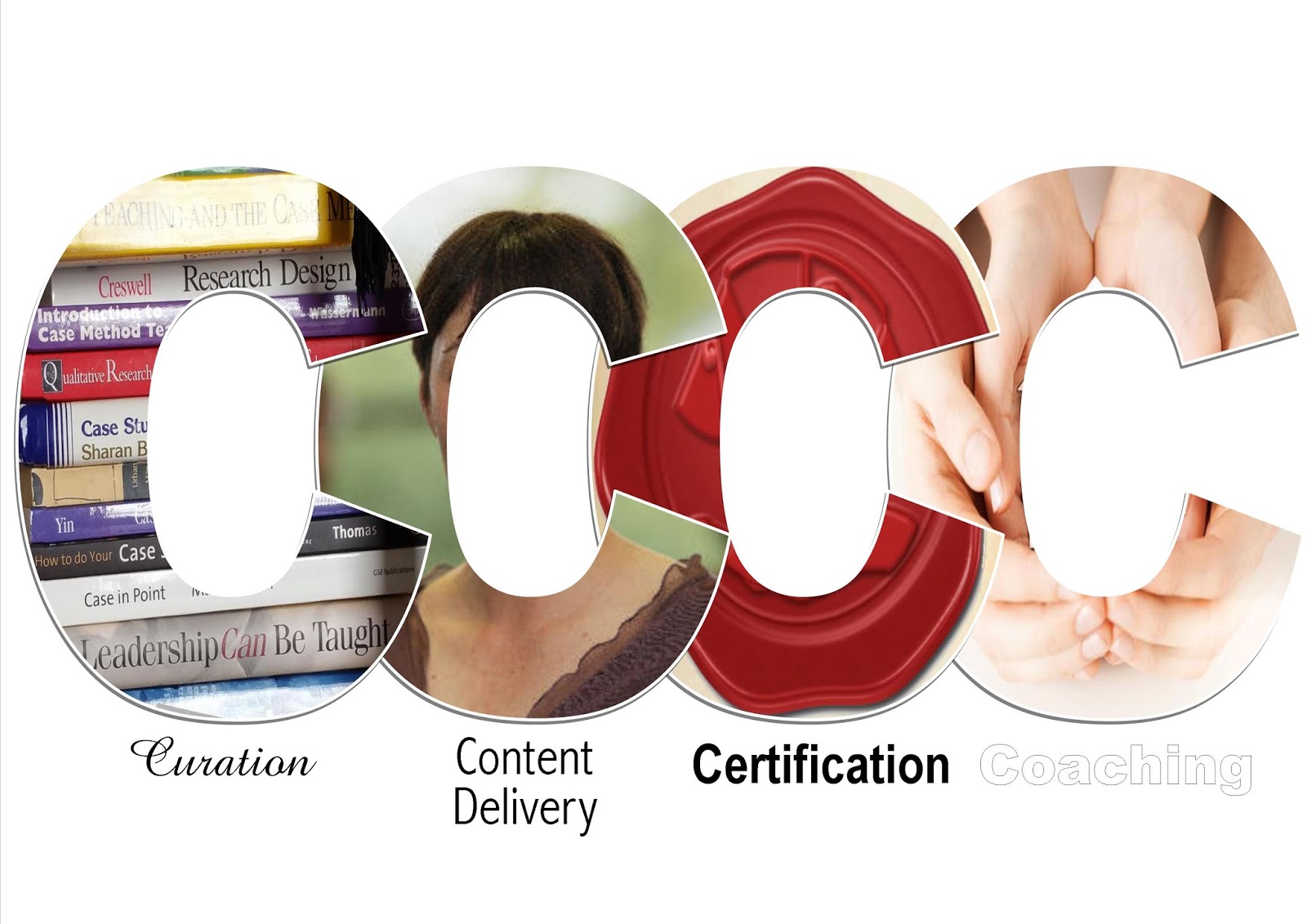
Matthew Roberts (2015) wrote a very interesting blog post about the act of teaching which resonated with me, detailing four areas of teaching which he proposed as curation, content delivery, certification and coaching.

I have called these the four Cs of Teaching - as I like mnemonics (and Matthew didn't call this model anything) (Roberts, 2015):

  1. Matthew proposed that the first C, curation, was developing learning outcomes, collecting relevant resources to clearly deliver those outcomes to our learners, and providing assessments that align with outcomes and resources so everyone is confident that learning has 'happened'. Appropriate curation is vital to ensure the desired learning takes place.
  2. The second C, content delivery, Matthew suggests is actually what most people mean by teaching. This is the front-end physical delivery in the classroom, as are textbooks, and journals. One person can deliver a lot of well-curated information to a great number of learners.
  3. C number three is certification, or, how we are sure that learning has taken place, and has stuck to the learners. This includes formative and summative assessments, grades, transcripts and qualifications. Assessment needs to be relevant, authentic, reliable and accurate... and, if certification only happens at the end, then it may be "too late to make any real improvement" without timely intervention of the last C. This too can be where good systems can check learning for a large number of people.
  4. The last C is coaching, which Matthew suggests is the "most ignored and the least glamorous" of the 4Cs. Coaching creates a partnership between teacher and learner: building a supportive, iterative and formative relationship where both parties can learn from each other. We can handle big numbers of students within the first three Cs, but this last essential ingredient is what transforms a mediocre talking-head into a great teacher. That individual dyad (partner) relationship needed for coaching clearly shows why one teacher cannot possibly meet the needs of thousands of MOOC students. There is simply not enough time to individualise the feedback needed for good, sticky learning to take place.
As Matthew said, "A good coach is known for the individual time they spend with each athlete, diagnosing their weaknesses, reinforcing their strengths, and offering customized remedial instruction in order to improve their performance" (Roberts, 2015).

True 'dat.


Sam
read more "The Four Cs of Teaching"