Pages

Showing posts with label Harvard. Show all posts

Friday, 7 July 2023

Some HRM history

HRM brings together a range of managerial approaches to the employment relationship. Beginning with ‘psychological assessment’ and the human relations movement 120 years ago, organisations began to considering workers as thinking and feeling beings who will perform better at work if their internal life - motivations, needs, hopes and expectations - is taken seriously by organisational leaders and managers.

Prior to the human relations school of thought, the school of 'scientific management' thought saw workers as typically motivated by financial rewards. Treated like cogs in a machine, staff could be shifted, monitored and replaced according to organisational needs. The human relations school proposes that a better way to manage workers is through encouraging motivation and commitment: rather than top-down surveillance and control.

Consider one of the leading models of HRM - which remains influential today - the Harvard model (Beer et al., 1984; see image). This remains one of the most popular HRM models, despite it's 40 year plus vintage. If you are interested in exploring the Beer et al (1984) text, create yourself an Open Library account (here) then get the book out at the Internet library (here).

It is important to understand the shared roles and responsibilities of organisations, managers, HR specialists and workers within the organisational system (Rudman, 2017). It is essential that HRM takes a systemic approach - or is allowed to take a systematic approach - so that organisational HRM activities are integrated, and that shared responsibility between members is embedded (Rudman, 2017). Alignment between worker objectives and organisation goals is a key element of sound HRM practice (aka the unitary frame of reference).

Unsurprisingly, treating staff as fellow human beings - with feelings, value, ethics and potential - yields rewards, and improves competitive advantage. Treating staff as replaceable cogs in a machine devalues the organisation, increases turnover and erodes commitment. 

Nothing about HR is really a surprise!


Sam

References:

Beer, M., Spector, B., Lawrence, P., Mills, D. Q. & Walton, R. (1984). Human Resource Management: A general manager’s perspective - texts and cases. Free Press. https://archive.org/details/humanresourceman00beer

Rudman, R. S. (2017). Chapter 2: Human Resources Management today. In HR Manager: A New Zealand handbook (2nd ed. pp. 37-56). Wolters Kluwer/CHH New Zealand.

read more "Some HRM history"

Wednesday, 17 March 2021

Learning Harvard Style

I am currently working with some colleagues in writing a research article for a journal which none of us have attempted publication in previously. We are all learning new things as a result.

One of the things I am struggling to get my head around is the fine nuances of Harvard Style citations and referencing, as there is an apparent paucity of handbooks which illustrate the intricacies. I am used to APA. I have written previous articles using APA. I know how to cite, how to quote, and how to reference all the tricky little things that we hardly ever need to think about.

I understand that arcane elements like white papers, multiple authors, and pre-press book chapters. But I don't even know where to go to find out with Harvard Style. I am reluctant to use MS Word's built-in referencing function, because I may rely too much upon it, and therefore not see rookie mistakes, and therefore jeopardise the acceptance of our article.

After a day of looking, I have finally found a Palgrave handbook called "Cite them Right" (Pears & Sheilds, 2019), which I hope may help me. Once I have digested the relevant chapters within the book, then I will be able to go forth and translate all our references into Harvard style from APA.

There are small things that catch us, such as no ampersand for multiple authors inside a bracket, but the use of an 'and' both inside and outside. "no date" is written in full instead of being abbreviated. "et al." is italicised. Book chapter citations include the page range in the citation bracket, even when not a quote. If quoting a webpage, we should include the paragraph number. URL home pages may be used as an author name instead of the actual author.

Article titles are in single quote marks in the reference list. References contain stub DOIs, and are preceded by "doi:". References have no full stops up until the page range with articles, or the end of the title with books. A page range is indicated with a "pp.". The publishing house location is included. There is no space between the author initials and the full stops.

Many elements look similar, which is good, but there are enough differences for me to need to be hyper-alert. This feels a little like attempting a new language: sometimes elements are so similar we can build off what we already know. And others are so different that they will make what we say incomprehensible.

Ah, well. Learning is learning: and no learning is ever wasted.


Sam

References:

read more "Learning Harvard Style"

Wednesday, 22 May 2019

De-stress and Create

Stress is an interesting thing. When stressed, I know I tend to stop looking for new information: instead I rely on systems I have already set up to carry me through, and I tend to worry about the team. So I was very interested to read a short from HBR about some tactics to get creative when we are stressed.

Attempting to relax by doing something different is the first step that Saunders (29 November 2018) offers: doing an activity that you know will allow your mind to wander. I thought of ironing (yeah, right!), swimming, walking or bathing the dog. Things that you can do on auto-pilot, so your thoughts can free-wheel. Keep your hands busy while the boys in the basement get to work (King, 1998).

The next step that she suggests is to get new information (Saunders, 29 November 2018). Your source could be a trip to the local library; getting some research articles; a trip to a local organisation to see how they tackle similar work; a networking event; a short course on the topic; a conference; or collaborating with others. New input should lead to new outputs.

The last point she makes is that we can't rush creativity. Ideas take time to form, so we need try not to get too attached to getting to a speedy outcome.


Sam

References:

read more "De-stress and Create"

Wednesday, 20 June 2018

A simple Career PD tool

Each week on a Wednesday as part of my professional development for my career practice I take a trawl through the online classifieds for work, on sites such as TradeMe Jobs and Seek. While there, I pick out interesting roles which my clients might like to apply for, along with changes in titles, and shifts in focus. Over time my weekly habit keeps me up to date with local trends, and helps me to better advise my clients as to qualifications, short courses and realignment of skills they may need in order to get into the work they aspire to.

Alongside this, I also look at roles which are similar to mine, to see what is now being asked for ...and to obtain the odd job description or two. In looking at career practice roles - though these roles don't come up very often - keeping on top of the evolving skill set and emerging areas of practice is very interesting. This helps me to think about what I should be doing for professional development in my own field, encouraging me to assess my own areas of expertise and find areas to upskill and add to my own toolkit.

It is surprising how much value such a simple practice can add. I had never thought about this habit as being worthy of a blog post until I recently read a post from Harvard's 'Management Tip of the Day' series more or less reiterating my own practice.
"You know it’s important to your career to keep learning new skills, but how do you know which ones to focus on? Start by looking at recent job postings from the top companies in your industry. Notice which qualifications keep popping up; the most common skills are probably the most essential. Next, reach out to people in your network who have a job you may want someday. Ask them what they’ve been learning to succeed in their roles. For example, if you want to know which skills and technologies are valued in sales, talk to some high-level salespeople. Also ask these experts whether they can recommend courses or other materials that will help you gain the skills you’re missing. And don’t feel intimidated about reaching out: Most people are happy to share this information, either because they like helping others or because doing so reinforces their expertise" (Harvard Business Review, 4 June 2018).

Hopefully something sparks here for you to apply an element of this practice to yourselves too, and make professional development easier.

Anything that makes keeping up to date less effortful has to be good :-)


Sam
read more "A simple Career PD tool"

Friday, 10 February 2017

Authentic leadership has become trendy


Authentic leadership is owning one’s personal experiences” and acting “in accord with the true self, expressing oneself in ways that are consistent with inner thoughts and feelings” (Harter, 2002, p. 382, cited in Avolio & Gardner, 2005).

Avolio et al nailed it when they said that authentic leaders are those who are deeply aware of how they think and behave and are perceived by others as being aware of their own and others’ values/moral perspectives, knowledge, and strengths; aware of the context in which they operate; and who are confident, hopeful, optimistic, resilient, and of high moral character” (Avolio, Gardner et al., 2004 as cited in Avolio & Gardner, 2005).

What is now taken in management-speak to be 'authentic' leadership is not what Avolio and Gardner talk about.

Popular media suggests that 'authentic' leadership is this something that all of us can achieve - or that we should all aspire to. However, authentic leadership is more trait theory than developmental theory. Maybe 5% of our population have the authentic capacity to lead this way.

I read two articles last year where writers who are usually pretty smart were were banging on about how all of us can learn to lead 'authentically'. This is not authentic leadership: it is PR. Buzzwords. Convenient. A fast fix.

Oops: and one that doesn't work.

For example, Herminia Ibarra wrote an article about leaders who tried to be vulnerable and open with their people - thinking this was authentic - and so got shot down or undermined. While her article focused on authentic leadership not being a panacea for all leadership problems, she missed the point that the people who were being taught this style of leading were not actually authentic leaders themselves. That they were being taught to be inauthentic authentic leaders.

Hermina goes on to say that authenticity is about one “true self”. Nazomi Morgan entitled her piece "Authentic Leadership Means Being Real". When people read these pieces, they assume authentic leadership is about 'truth'.

This is not what authentic leadership is. From what I have quoted above, we know that authentic leadership is a particular leadership style where leaders are socially aware, high-functioning optimistic people who actions, thoughts and words are invariably consistent.

So just remember: authentic leadership is a style confined to those who (a) demonstrate and (b) work on those traits mentioned.

We can learn to be more authentic, but if we don't have authentic leadership traits, we can't be an authentic leader. We would be foolish to try to stick this style on like a band aid, because our future thoughts, words, and actions will not be consistent. We will undermine ourselves.

We would be better to be true to ourselves and NOT try to be an authentic leader, but be a participative leader, or a facilitative leader, or an autocratic leader... whatever our natural style is, as well-developed and functioning as we can make it.

Otherwise we get the whole silk purse, sow's ear thing happening...


Sam


References:
read more "Authentic leadership has become trendy "

Monday, 20 June 2016

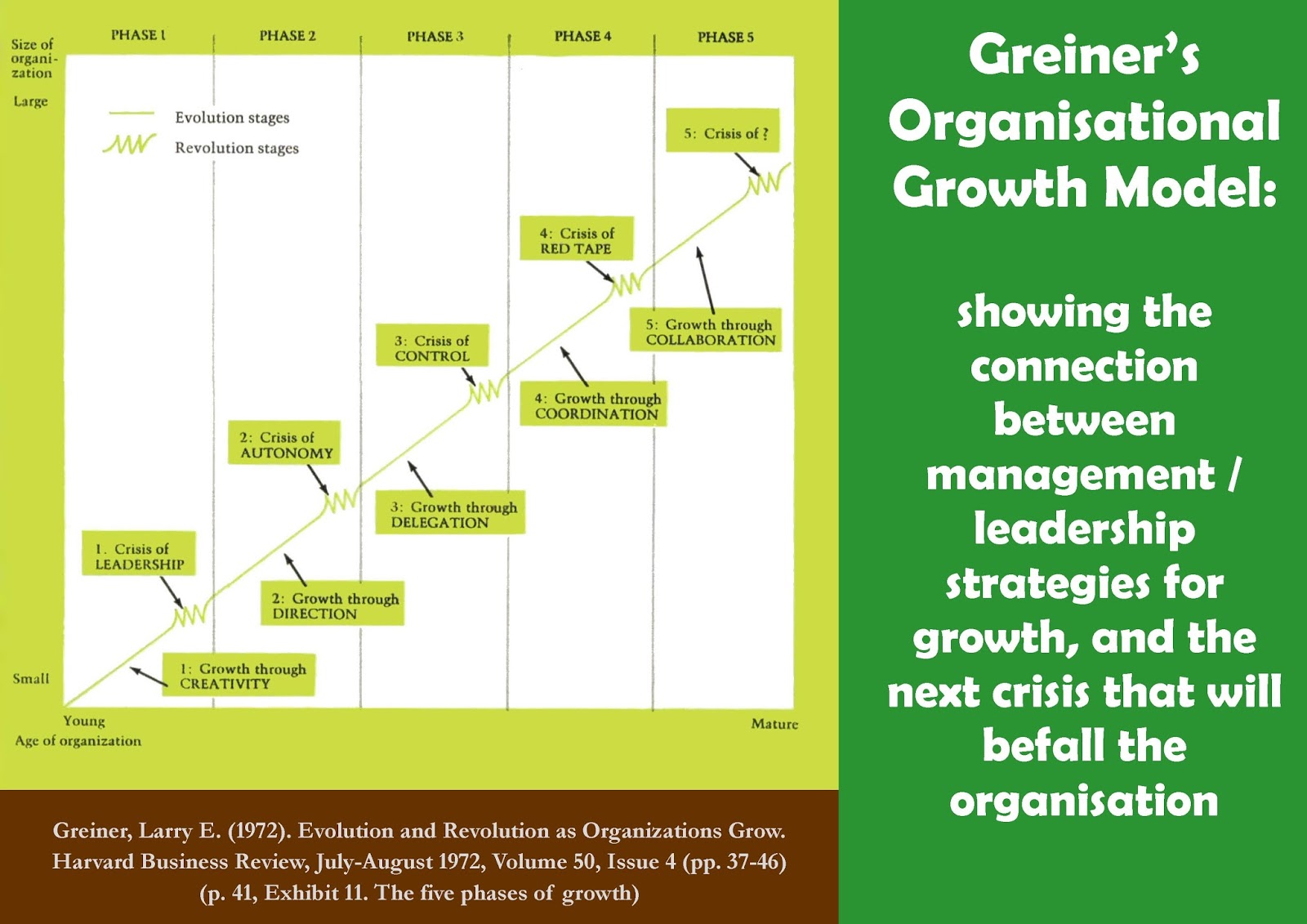
Greiner's Organizational Growth Model

When I was studying my undergraduate degree, I had a lecturer who showed my cohort of management 101 students Greiner's Organizational Growth Model (1972).

Being a newbie, I took absolutely no notice of whose model it was. I remembered the stages - they were, in fact, emblazoned on my memory - but I had no recollection whatsoever of who had done the thinking.

Last year, I was explaining 'crisis of control' in organisations to some of my leadership students, who appeared completely ignorant of the concept that different crises could strike an organisation at different stages of its development (rather like the product life-cycle, in fact). In realising that, I also realised that I had no idea of whose developmental work this had originally been.

So I went looking, but was unable to find what I was looking for: despite fairly thorough Google and GoogleScholar searches.

Then, as serendipity would have it, I recently attended a webinar on peer coaching in the workplace. One of the presenters mentioned what sounded like "Griner's model", and "crisis of control", and I had enough to find the name of my missed theory developer from all those years ago. A quick search later and Google knitted the two fragments into a solution for me.

Larry Greiner (1972) originally observed that organisations appear to go through different stages of development at different times in their 'lives', with each of those stages needing different strategies, tactics and actions to manage and develop the organisation appropriately, readying it for the transition to the next stage. 

Greiner's crises were crises of leadership; autonomy; control; red tape; and an indication that there were further crises, but an implication that their nature is unknown. Each crisis is driven by a preceding growth stage (1998).

Starting with five growth stages, Greiner (1998) later added a sixth stage, but didn't indicate a crisis for that one - a fact which I find interesting. The growth - or development - stages are (Value-Based Management, n.d.):
  1. Creativity: characterised in a company start-up, entrepreneurship, informal communication, hard work, and poor pay; ending with a crisis of leadership
  2. Direction: characterised by sustained growth, functional organisation structures, accounting, capital management, incentives, budgets, and focusing on process standardisation; ending with a crisis of autonomy
  3. Delegation: with decentralised organisational structures, decentralised operational and decentralised marketing, profit centres, financial incentives, decision-making based on periodic reviews, senior management acts by exception, and using formal communication channels; ending with a crisis of control
  4. Co-ordination and monitoring: having a product group structure, in-depth formal planning reviews, supporting function centralisation, corporate staff overseeing co-ordination, corporate capital expenditures, accountability for ROI at product group level, and motivating through lower-level profit sharing; ending with a crisis of red tape
  5. Collaboration: taking a new evolutionary path, using problem-solving teams and cross-functional task teams, decentralising support staff, adopting a matrix structure, simplifying control mechanisms, team behaviour education programmes, advanced information systems, and team incentives; ending with a crisis of internal growth
  6. Extra-organisational solutions: mergers, holdings, networks of organisations.
One of the key aspects of Greiner's model is that it flags which management theories or leadership styles will work at the various stages: which then shows us by omission which won't

I wonder, if he were still thinking about this now, whether Greiner would have come up with a crisis for the 'extra-organisational solutions' stage? Perhaps, in considering the GFC, a crisis of hubris?


Sam

References:
    read more "Greiner's Organizational Growth Model"

    Thursday, 19 September 2013

    Fake it Until You Become it

    If you have haven't Amy Cuddy before, she is a US Social Psychologist who teaches at Harvard and researches body language. She developed the Stereotype Content Model along with Susan Fiske and Peter Glick, which uses dimensions of warmth and competence to evaluate behaviours.

    In 2012 Amy did a TED talk in Scotland on what we can learn and draw from using powerful body language. With fellow researcher Dana Carney, Amy found that the body language we use can increase our resilience to stress by lowering cortisol, and increase our confidence by increasing our natural amounts of testosterone. This happens all through using power poses which affect those hormones - testosterone and cortisol - for only two minutes before we go into evaluations, stressful meetings, situations where we are nervous, or confrontation. When our body moves in a certain way, hormones are released, and we react to the hormones by feeling more positive in those situations.

    What is very interesting about her research results is that this means that we can all improve our self-image and our likely self-confidence just by how we hold ourselves. We can all improve our self-leadership potential, and make our own acts of leadership more likely just by deliberately moving our body to a more powerful pose.

    That old phrase "gird your loins" never had more meaning.

    Listen to Amy's TED talk "Amy Cuddy: Your body language shapes who you are".

    Embrace Amy's message. You will benefit from it!

    Sam

    References:

      Cuddy, A. (2012). Your body language shapes who you are [video]. Scotland: TED. http://www.youtube.com/watch?v=Ks-_Mh1QhMc

    read more "Fake it Until You Become it"