Pages

Showing posts sorted by relevance for query Maslow. Sort by date Show all posts

Wednesday, 20 May 2020

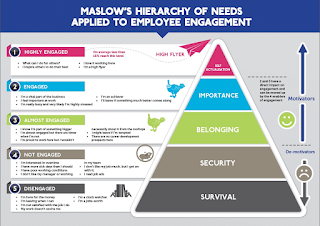
The pyramid scheme that was Maslow

Source: Thompkins-Jones (24 July 2014)
In 1943, a psychologist called Abraham Maslow presented a framework in a paper proposing that we humans had a stepped range of needs, called the hierarchy of needs. Maslow says in his paper that while the needs appear to be progressive, they are not equally important to individuals, and further notes that he does not want to "give the false impression that a need must be satisfied 100 per cent before the next need emerges" (1943, p. 389). He provides an example that an average person might reach "85 per cent in [their] physiological needs, 70 per cent in [their] safety needs, 50 per cent in [their] love needs, 40 per cent in [their] self-esteem needs, and 10 per cent in [their] self-actualization needs" (p. 390). And note those headings: they too have changed since Maslow wrote his original psychology paper.

Researcher John Ballard hunted through the "Maslow archives at the Center for the History of Psychology at the University of Akron in Ohio", and after an extensive and wide-ranging research programme with his fellow authors, Todd Bridgman and Stephen Cummings, "found no trace of Maslow framing his ideas in pyramid form” (2019, p. 82). They further note that up until the 1980s, the preferred model for Maslow's hierarchy of needs was a ladder, where the reader could imagine simultaneous points of contact with different rungs. This ladder framework is more in keeping with what Maslow outlines in his original 1943 paper. Maslow's ideas do not fit a pyramid.

What is also interesting is how Maslow's work transferred from psychology to management. Bridgman et al. state "Douglas McGregor [..] encountered it in 1944 and drew on it in developing his famous Theory X and Theory Y concept" (2019, p. 84). Correspondence which followed between the two academics resulted in McGregor championing the hierarchy of needs; in industry, at conferences, and publishing papers about it. McGregor's interest arose at an opportune time when returned service people were coming back from WW2 in Europe and the Pacific, and enrolling at university. The GI Bill for returned service people included fully-funded MBAs from a grateful American public.

It was McGregor who made Maslow famous, although until the early 1960s, Maslow's thinking which inspired McGregor's Theory X and Theory Y was hidden, unacknowledged, within McGregor's work (Bridgman et al., 2019). Maslow's hierarchy first appears as a demi-ziggurat image by Davis (1957, as cited by Bridgman et al., 2019), and then as a pyramid from McDermid (1960, as cited by Bridgman et al., 2019). Both of models are clearly targeting business readers, being published respectively in Human Relations in Business, and Business Horizons (Bridgman et al., 2019). Maslow is now a management hot property, complete with a shape which means change in mathematics, with the layers of the model named as physiological needs, safety, social, esteem, and self-realisation needs (McDermid, 1960, as cited by Bridgman et al., 2019). Note the changes of rung names from paragraph one.

Many elements got lost as time ticked on, such as Maslow's initial idea that people can be at many stages, all at once (1942). In a later book, Maslow talks about transcendence, which seems to imply there may be a level past that of self-actualisation (1962). Maslow also proposes that, to be healthy and to grow, humans need to use their capacities - such as striving, physiology, intelligence, and love - or potentially may suffer from either physical or psychic disease (1962). These ideas have not been reflected in the pyramid that the management field has adopted.

After the experiences of WW2, Maslow sought peace, yet we have "ignore[d] some of [his] more egalitarian principles" (MacLellan, 2019). Additionally, Maslow had some interesting ideas about women - saying about Mexican women that "one woman is about as good as another, and that she is interchangeable with others. She discovers that she is not valuable; it is the class 'woman' that is valuable" in the eyes of Mexican men (1962, p. 121). Ouch.

Maslow was a free-thinker, and his thinking probably still has value: even if we have not been able to gather research evidence that his model actually works in practice. We do, however, need to remind ourselves that his model is: (a) not a pyramid; (b) not sequential; (c) not absolute; and (d) is not a management model.

If we read what Maslow originally wrote, then it is a useful as a lens to consider what may be holding us - or others - back.


Sam

References:
read more "The pyramid scheme that was Maslow"

Wednesday, 10 September 2025

Te Whare Tapa Whā & Maslow

Mason Durie's holistic wellness model (1985), Te Whare Tapa Whā, has been discussed before (here), but there is always more we can explore.  Health and government agencies in Aotearoa have used Te Whare Tapa Wha for forty years, including as a self-assessment tool for training new recruits in the Defence Forces (MAS Team, 2024). 

Te Whare Tapa Whā was created in 1982 (Durie, 1985), consisting of four pou, or pillars, for "life – te taha hinengaro (psychological health); te taha wairua (spiritual health); te taha tinana (physical health); and te taha whānau (family health)" (Careers New Zealand, 2020).

What is really interesting is that the four pou of Te Whare Tapa Whā align quite well with Maslow's Heirarchy of Needs (see the image accompanying this post (Purohit, 2024, p. 11). For example, te taha tinana (Durie, 1985) aligns with safety and psychological needs (Maslow, 1943); te taha whānau (Durie, 1985) with belonging and love needs (Maslow, 1943); te taha hinengaro (Durie, 1985) to esteem needs (Maslow, 1943), and te taha wairua (Durie, 1985) to self-actualisation (Maslow, 1943).

However, Maslow's Hierarchy of Needs (1943) has been taught in a very structured way: that until our physiological needs are met, we cannot move up the model to self-actualisation. Yet Maslow intended the five areas of his model to be rungs on a ladder not a pyramid (Bridgeman et al., 2019, more here). Our individual priorities might mean we meet some areas more than others: Maslow does not want to "give the false impression that a need must be satisfied 100 per cent before the next need emerges" (1943, p. 389). The following example shows that a person might reach "85 per cent in [their] physiological needs, 70 per cent in [their] safety needs, 50 per cent in [their] love needs, 40 per cent in [their] self-esteem needs, and 10 per cent in [their] self-actualization needs" (Maslow, 1943, p. 390). This, more accurate view of Maslow (1943), fits in better with Te Whare Tapa Whā (Durie, 1985). 

All four pou of Te Whare Tapa Whā can also be at differing stages of development (Durie, 1985). At different times of our life we will need to focus on different areas. Helping others to grow their “self-awareness is key to creating balance and harmony in all aspects of life, including career development” (Careers New Zealand, 2020), while embedding all four components over time will hopefully establish more “fulfilling and sustainable professional" working lives (Passmore, 2023). 

It is interesting to see the similarities across national divides of models, birthed within different philosophies, which can be used in similar ways to help others. 

And we have a national Taonga.


Courtnay & Sam

References:

Bridgman, T., Cummings, S., & Ballard, J. A. (2019). Who Built Maslow’s Pyramid? A History of the Creation of Management Studies’ Most Famous Symbol and Its Implications for Management Education. Academy of Management Learning & Education, 18(1), 81–98. https://doi.org/10.5465/amle.2017.0351

Careers New Zealand. (2020, October 18). Te Whare Tapa Whā. https://www.careers.govt.nz/resources/career-practice/career-theory-models/te-whare-tapa-wha/

Durie, M. H. (1985). A Maori perspective of health. Social Science & Medicine, 20(5), 483-486. https://doi.org/10.1016/0277-9536(85)90363-6

MAS Team. (2024). Well in every way - Te Whare Tapa Whā. Mas. https://www.mas.co.nz/hub/well-in-every-way-te-whare-tapa-wha/

Maslow, A. H. (1943). A theory of human motivation. Psychological Review, 50(4), 370-96. https://doi.org/10.1037/h0054346

Passmore, S. (2023, September 25). Applying Te Whare Tapa Wha to Career Wellbeing. https://www.pickapath.co.nz/post/applying-te-whare-tapa-wh%C4%81-to-career-wellbeing

Purohit, P. (2024). EPIC Transformations: Redefining Career Paths for Solo Parents in the New Era by Leveraging the Te Whare Tapa Whā Framework- a Māori Healthcare Model [Image]. In the Proceedings of the Asia Pacific Career Development Conference (APCDA). https://asiapacificcda.org/wp-content/uploads/2024/06/apcda_cp0001_03.pdf

 * Courtnay Fraser has kindly prepared much of the material for this post

read more "Te Whare Tapa Whā & Maslow"

Monday, 2 February 2026

So what is Maslow's hammer?

If you have not heard of "Maslow's hammer" before, you still may have heard the saying "it is tempting, if the only tool you have is a hammer, to treat everything as if it were a nail" (Maslow, 1966, p. 15-16). This is the saying known as Maslow's hammer.

Maslow is talking about our practice becoming formulaic and process-oriented. So whenever a new client comes in, and we get them to complete the O*Net Inventory. We forget to see the client in front of us for who they are as people, and what their unique needs are. As others have said, it is a "human tendency to be overreliant on a familiar tool to the exclusion of other potentially more appropriate tools" (Giangreco, 2021, p. 281). This human tendency is also known as 'solutionism', where we forget "to consider the appropriateness of [our] solutions" for the situation we find ourselves in, and the client we are with (Looi et al., 2021, p. 2).

So instead, let us begin by being client-centred in our practice, and first having a kōrero with our client and finding out what they would like to achieve. We might need a screw driver. Or a polishing cloth. Or a mirror. We might need the hammer, but much later, after we have used our tweezers :-)

Abraham Maslow was a US industrial psychologist who has become famous for his Hierarchy of Needs diagram (read more here). And I think there is another layer to the Maslow's hammer saying: I think our training can also make us blind. For example, sand is likely to appear as: a liquid ingredient to a glass blower; an abrasive to a carpenter; a resting place to a swimmer; a mandala base to a Buddhist monk, and a former mountain to a geologist. Our perspective - our training - can also colour what we see.

Staying creative, staying in the moment and being present with our client can help us, to help our client to see.

Because when we see a client, it is not about us. It is about the person who has come to us for advice. And if we can stay focused on that, we are much less likely to use a hammer regardless of what job we are aiming to deliver.


Sam

References:

Giangreco, M. F. (2021). Maslow’s hammer: Teacher assistant research and inclusive practices at a crossroads. European Journal of Special Needs Education, 36(2), 278-293. https://doi.org/10.1080/08856257.2021.1901377

Looi, J. C., Bonner, D., & Maguire, P. (2021). Maslow’s hammer: considering the perils of solutionism in mental healthcare and psychiatric practice. Australasian Psychiatry, 29(6), 687-689. https://doi.org/10.1177/10398562211005438

Maslow, A. (1966). The Psychology of Science: A reconnaissance. Gateway Editions, Ltd.

read more "So what is Maslow's hammer?"

Friday, 15 March 2019

Evidenced-based teaching

Mary Parker Follett said, "Business [...] is pioneer work [... using] the organized relations of human beings, [and] seems to me to offer as thrilling an experience as going into a new country and building railroads over new mountains" (1942, p. xxi). Despite the phrase "organized relations" implying theory, this sounds like the siren call of the wild, an experiential dive into the frontiers of business. But we rarely create new ideas in business: we tend use old ideas - theories - in new ways.

Management researcher Kurt Lewin wrote that "a business man once stated that 'there is nothing so practical as a good theory'" (1943, p. 118). Much of my management teaching has been shaped by that underpinning idea: that theory is the codifying of practical application in the field. A good theory is the tried and tested recipe for getting things done with people, efficiently and effectively.

Theories are the starting place to teach practice. They get tested through application. They will change and evolve over time as our knowledge of causal and contributory factors improves. When I teach, I start with theory, break it down, and get students to apply it, find other examples, and try it for themselves.

But what is interesting is that many of our most beloved theories have little evidence to underpin them. For example, Maslow's Hierarchy of Needs (1943) looks logical - i.e., that we cannot move onto self-actualisation if our physiological needs are unmet - yet to the best of my knowledge, there have been no research which proves the model 'works' in toto. What is also interesting is that we didn't even include his final layer of 'Transcendence', which proposes that the model's highest level is doing things for altruistic reasons (Maslow, 1971).

I am not suggesting that we shouldn't teach theory. I am suggesting we teach theory alongside the evidence. We keep using old 'tried and tested' models, but we must discuss the 'tested' and explore how replicable they have been found to be.

Additionally, there is a further aspect of theory we need to consider: how appropriate the use of a theory is in a particular situation. As Wood, Phan and Wright suggested, we "don’t ask often enough why a particular theory should be applied to a particular phenomenon and, more important, if it makes sense to impose a theory on that phenomenon" (2018, p. 405). We may overly complicate already complex environments by trying to impose a new fad, or an ill-fitting model. I have seen this in workplaces which jumped in on the LEAN (Ohno, 1988) rush a few years ago, in organisations which were not trained for it; not philosophically ready for it; and not truly supportive of it. This lead to disillusioned staff, wasted effort, and fewer available resources: the opposite of what the application of the theory was intended to do.

If we want to keep theory practical, we need both applicability, and appropriateness. Something to remember.


Sam

References:
  • Follett, M. P., & Metcalf, H. C. (Ed.) (2003). Dynamic administration: The collected papers of Mary Parker Follett - Early sociology of management and organizations. USA: Psychology Press.
  • Lewin, K. (1943) Psychology and the Process of Group Living. The Journal of Social Psychology, 17(1), 113-131. http://dx.doi.org/10.1080/00224545.1943.9712269
  • Maslow, A. H. (1971). Farther Reaches of Human Nature. New York, USA: The Viking Press.
  • Maslow, A. H. (1943). A theory of human motivation. Psychological Review, 50(4), 370-96. https://doi.org/10.1037/h0054346
  • Ohno, T. (1988). Toyota production system: beyond large-scale production. USA: CRC Press.
  • Wood, G., Phan, P. H., & Wright, M. (2018). The Problems With Theory and New Challenges in Theorizing. Academy of Management Perspectives, 32(4), 405-411. https://doi.org/10.5465/amp.2018.0123
read more "Evidenced-based teaching"

Monday, 29 December 2025

Theory X and Theory Y

Maslow's work on his Hierarchy of Needs was transferred from psychology to management, where "Douglas McGregor [..] encountered it in 1944 and drew on it in developing his famous Theory X and Theory Y concept" (Bridgman et al., 2019, p. 84).

The basis of the theory is that Theory X managers takes an authoritarian approach, assuming their staff dislike work, are inherently lazy, requiring strict supervision and monitoring; while Theory Y managers are participatory, thinking their people love their work, are self-motivated and will thrive in a supportive, team environment (Daft, 2022).

  • Theory X: Staff inherently dislike of work and will avoid it if they can; because staff don’t like work, most need coercion, controlling, directing, or the threat of punishment to make them deliver what the organisation needs; and staff prefer being told, don’t want responsibility, are not ambitious, and seek security more than anything else (Daft, 2022).
  • Theory Y: Most staff like working: it’s as normal as rest or play; control and threatening punishment are not necessary to have staff work hard to meet organisational goals; staff can self-manage if they care about the goals they’re working on; most staff, if supported well, will take on, and seek responsibility; most staff are innovative and can problem-solve with imagination, ingenuity, and creativity if asked; and most staff talents “are only partially utilized” (Daft, 2022, p. 140).

This assumption - a philosophy of management, if we will - colours the approaches and decisions these managers take with their staff in a myriad of ways. A Theory X manager will manage staff with high control, low trust approach. They are likely to be more detailed about punctuality, breaks, and following the rules. A Theory Y manager is more likely operate a low control, high trust model. They will be more big picture about making the right product for the customer, and once targets are met, everyone celebrates.

We can find that a Theory X manager might be appropriate for new staff: a "telling" approach like the 1969 Hersey Blanchard life cycle theory of leadership (Blanchard & Hersey, 1996). However, once staff become more experienced, a manager who is between the X and Y types will allow more "participation" and can increase or relax control to suit the employee (Blanchard & Hersey, 1996). Then, once staff are very experienced, a manager can move to a Theory Y style: a "delegating" approach (Blanchard & Hersey, 1996). Perhaps we could think of McGregor's work less like two styles, and more like a continuum in shades of grey.

What I also find interesting is that Douglas McGregor took 16 years to formalise his thoughts from encountering Maslow's work in 1944, to formalising his theory in 1960 (Bridgman et al., 2019; Daft, 2022).


Sam

References:

Bridgman, T., Cummings, S., & Ballard, J. A. (2019). Who Built Maslow’s Pyramid? A History of the Creation of Management Studies’ Most Famous Symbol and Its Implications for Management Education. Academy of Management Learning & Education, 18(1), 81–98. https://doi.org/10.5465/amle.2017.0351

Blanchard, K. H., & Hersey, P. (1996). Great ideas revisited. Training & Development, 50(1), 42-48.

Daft, R. L. (2022). The Leadership Experience (8th ed.). Cengage Learning.

McGregor, D. (1960). The Human Side of Enterprise (1st ed.). McGraw-Hill Book Company, Inc.

read more "Theory X and Theory Y"

Wednesday, 7 March 2018

Heutagogy: the art of self-directed learning

The Difference Between Pedagogy, Andragogy,
And Heutagogy (Heick, 5 November 2015)
What do you know about heutagogy? I hadn't even heard about this a few months ago, until a travelling expert in this area came to do a seminar at my institution. Then I learned a few things.

Heutagogy was defined in 2000 by Hase and Kenyon as "self-determined learning" and is based on the idea of knowledge-sharing over knowledge-hoarding. It picks up Argyris's idea of double-loop learning, and reflecting about the how and the why of our learning (2002). I like that. Research projects and theses are heutagogic.

Heutagogy is a step beyond andragogy (adult learning; Knowles, 1980), and into self-reflective, -directed and -determined learning. Learners not only build the plan, they negotiate their own path, outline the field, and map the territory (Heick, 5 November 2015; Blaschke, 2012; Argyris, 2002; Hase & Kenyon, 2001; Hase & Kenyon, 2000). Heutagogy is a philosophical approach that aims to help learners self-develop as problem-solvers, trouble-shooters and action-takers making continuous improvement: those who can work developmentally in learning organisations.

The idea is that the learner drives the learning completely, independently, and does not follow a linear route. The learner seeks self-actualisation (Maslow, 1962). The 'teacher' is simply a guide on the side (King, 1993); a facilitator.

It is quite an interesting idea. I will come back to it in a later post.


Sam

References:
  • Argyris, C. (2002). Double-Loop Learning, Teaching, and Research. Academy of Management Learning & Education, December, 1(2), 206-218
  • Blaschke, L. M. (2012). Heutagogy and lifelong learning: A review of heutagogical practice and self-determined learning. The International Review of Research in Open and Distributed Learning, 13(1), 56-71.
  • Blaschke, L. M., & Hase, S. (2016). Chapter 2 - Heutagogy: A holistic framework for creating Twenty-First-Century self-determined learners. In B. Gros, Kinshuk, & M. Maina's (Eds) The Future of Ubiquitous Learning. Berlin, Germany: Springer Berlin (pp. 25-40)
  • Hase, S., & Kenyon, C. (2001). Moving from Andragogy to Heutagogy in Vocational Education. In Research to Reality: Putting VET Research To Work. Proceedings of the 4th Conference of the Australian Vocational Education and Training Research Association (AVETRA), in Adelaide Australia, 28-30 March 2001.
  • Hase, S. & Kenyon, C. (2000). From Andragogy to Heutagogy. ultiBASE In-Site, December, ISSN 1328-1798. Retrieved 15 January 2018 from http://pandora.nla.gov.au/nph-wb/20010220130000/http://ultibase.rmit.edu.au/Articles/dec00/hase2.htm
  • Heick, T. (05 November 2015). The Difference Between Pedagogy, Andragogy, And Heutagogy. Retrieved 13 November 2017 from https://www.teachthought.com/pedagogy/a-primer-in-heutagogy-and-self-directed-learning/
  • King, A. (1993). From Sage on the Stage to Guide on the Side. College Teaching, Winter, 41(1), 30-35. https://doi.org/10.1080/87567555.1993.9926781
  • Knowles, M. S. (1980). The Modern Practice of Adult Education: From pedagogy to andragogy. USA: Prentice Hall
  • Maslow, A. H. (1962). Toward a psychology of being. USA: D Van Nostrand Company Inc.
read more "Heutagogy: the art of self-directed learning"

Monday, 3 February 2020

Leader frames of reference

A question on Quora caught my eye recently: "What is [a] symbolic culture?".

It is a good question, and I wondered if the questioner was actually asking about a symbolic 'frame' which is one of four proposed leader frames of reference for effective leadership. The leader frames were developed by Professors Lee Bolman and Terry Deal, with their book on the subject, Reframing Organizations: Artistry, Choice and Leadership, first published in 1991. The fifth edition was published in 2017.

What Bolman & Deal propose is that each 'frame' is a lens we use to understand, to gather information, to make decisions, and to use our power over the world around us. They suggest that there are four main frames of reference that we use: a structural frame, a human resource frame, a political frame and a symbolic frame (1991).

The image above is how Richard Daft (2007) summarised Bolman and Deal's model (1991): implying that there is a hierarchy in the level of thought: a step up from the applied to the holistic, if you will. I like this presentation of the frames model, as it ties in well with Herrmann's HBDI model (2000), the behavioural meta-theory of task and relationship factors (Daft, 2007), Morgan's metaphors (1986), and Maslow's (1943) original idea that people move from the concrete (basic) to the cerebral (self-actualisation).

The four frames are:
  1. Structural: Like Morgan's metaphors (1986), this is the organisation as a machine; or like HBDI's (2000) logical / analytical sector, total focus on the numbers. Here leaders focus on machine-like decisions based on economics and efficiency. Plans and goal setting are very important, with leaders using position power to 'influence' followers. Followers are 'led' using goals and clear job expectations (like House's Path Goal theory, 1996). All the task-oriented data is used: job descriptions, numbers, policy, standards and profit. Behaviours rewarded are order, logic, efficiency & continuity. Leaders display behavioural, task-oriented leadership, with dashes of contingency theory and transactional leadership. This frame's danger is leadership rigidity - which can support very dominant, autocratic leaders.
  2. Human Resources: This is a very relational frame, like HBDI's interpersonal frame (2000), the relational element of the behavioural meta-theory (Daft, 2007), or Morgan's metaphor of organisations as cultures (1986). People are considered to be the most valuable organisational resource, where problems are thought-through considering human factors, and the organisation makes adjustments to meet individual needs. Leaders focus on dyad (Graen & Uhl-Bien, 1995) relationships and feelings, empowering and supporting followers to achieve, encouraging open communication. This is a developmental frame with leaders involving followers, providing opportunities for individual's personal and professional growth. Leadership styles include servant leadership, stewardship (Kaitiakitanga), values-led leadership, and some shared leadership styles. Where this frame can come unglued is when the strategic organisational outcomes become subsumed by follower's views: where the leader's care prevents important goals from being achieved.
  3. Political: Again, coming back to Morgan's metaphors (1986), organisations can be one of the either instruments of domination, or psychic prisons, or political systems; or to consider Martin's power frame of a 'jungle' from her differentiation lens (1992). Political organisations are all about 'the man [...] in the arena' (Roosevelt, 1910), but instead of courage, they are full conflict and tension. It is a fight to obtain scarce resources, with winners climbing over the bodies of the dead and wounded left behind (ouch). Leaders focus on developing alliances, cabals and power-bases to influence decisions and outcomes. Leaders use personal & organisational power to drive-through results. While effective political leaders use negotiating and coalition-building skills to serve the organisation, power and politics are often covert, resulting in hidden agendas and the subsummation of organisational goals. Deception, dishonesty, and the feathering of individual nests are very real risks of this frame.
  4. Symbolic: This frame aligns with Morgan's metaphors as the brain, or as a culture (1986). The organisation uses shared meaning, values, and a shared vision. Leaders use vision, culture and values to influence followers. Cultural elements such as rituals, ceremonies, stories, symbols and 'priests' grow the organisational culture (Deal & Kennedy, 1982). These leaders are likely to lead through transformational styles (eg authentic, visionary, values-led, etc), or charisma. Followers are inspired to perform well, and to be committed to the cause. This frame can derail leaders over time by megalomania (particularly charismatic leaders) or with 'messiah' complexes. Symbols can also become dishonest, unethical, or self-serving.
The elements of danger mentioned above for each frame illustrate what happens if we focus too much on any one frame. We are human. We are each likely to have a preference for working in one, two or three frames: few of us are competent in all four (and this too aligns well with HBDI). Leadership requires us to use all four frames to be effective, so we need to develop our skills in those where we are weak, otherwise we may fall into one or more of the dangers above.

We are all constant piece of work in progress!


Sam

References:
  • Bolman, L. G. & Deal, T. E. (1991). Reframing Organizations: Artistry, Choice and Leadership. San Francisco, USA: Jossey-Bass.
  • Bolman, L. G. & Deal, T. E. (1988). Modern approaches to understanding and managing organizations. San Francisco, USA: Jossey-Bass.
  • Daft, R. L. (2007). The Leadership Experience (4th edition). USA: Thomson South-Western
  • Deal, T. E. & Kennedy, A. A. (1982). Corporate Cultures: The Rites and Rituals of Corporate Life. USA: Addison-Wesley Publishing Company, Inc.
  • Graen, G. B., & Uhl-Bien, M. (1995). Relationship-based approach to leadership: Development of leader-member exchange (LMX) theory of leadership over 25 years: Applying a multi-level multi-domain perspective. Leadership Quarterly, 6(2), 219-247. https://doi.org/10.1016/1048-9843(95)90036-5
  • Herrmann, N. (2000). The Theory Behind the HBDI and Whole Brain Technology. Retrieved from https://heikejordan.de/artikel/TheTheoryBehindHBDI.pdf
  • House, R. J. (1996). Path-goal theory of leadership: Lessons, legacy, and a reformulated theory. The Leadership Quarterly, 7(3), 323-352. https://doi.org/10.1016/S1048-9843(96)90024-7
  • Martin, J. (1992). Cultures in Organizations: Three perspectives. USA: Oxford University Press
  • Maslow, A. H. (1943). A theory of human motivation. Psychological Review, 50(4), 370-96. https://doi.org/10.1037/h0054346
  • Morgan, G. (1986) Images of Organization. USA: Sage Publications, Inc.
  • Roosevelt, T. (1910). Citizenship in a Republic. Speech: Sorbonne Universite, Paris, France, April 23, 1910
read more "Leader frames of reference"

Friday, 14 February 2020

The Myth of Digital Natives

Many of us drank the Kool-Aid on this one: the concept of digital natives.

The idea behind the digital natives concept was that those born after 1980 would be so normalised to technology that they would effortlessly understand its use and would outstrip those older than themselves in technological nous, application and efficiencies (Prensky, 2001a, 2001b, 2005, 2009).

It was a great premise, but it wasn't borne out by the research (Brown & Czerniewicz, 2010; Margaryan & Littlejohn, 2008; Stoerger, 2009). Koutropoulos (2011) summarised Prensky's arguments, illustrating some of the fallacies in the assumption that younger people will naturally be sound users of technology.
  • Firstly the argument assumes a binary state: younger people are 'digital natives' because they were born since the advent of computers. Those born before computers are 'digital immigrants' (Koutropoulos, 2011). We are each one or the other, and we cannot change our base state. This idea seems to fall back into the 'born verus made' argument, or the idea of horoscopes. The science doesn't indicate that if we are born on a certain date that we are imbued with certain characteristics (and there is some argument about whether the date is 1980 or 1984). Further, the idea of a date with before and after contains an implied power relationship: the 'digital natives' own technology skills, while the 'immigrants' don't (Koutropoulos, 2011). It also implies that education is futile: there is no point training older people because they are 'digital immigrants' and therefore can't learn (Helsper & Enyon, 2011).
  • Secondly, the argument appears to have made an assumption that 'digital natives' everywhere will have the same access to technology, the same desire to use technology, and the same ability to understand and learn technology. This too is not borne out by the research. Research into 'digital natives' in South Africa, the UK, the US, and Australia reflect differing levels of technology access, uptake, and focii (Brown & Czerniewicz, 2010; Koutropoulos, 2011; Margaryan & Littlejohn, 2008; Stoerger, 2009).
  • Thirdly, we could reasonably expect 'digital natives' to be superb users of technology. The use of technology apparently rewires their brains to process information differently to previous generations. Research has found this to be unsupported by evidence (Brown & Czerniewicz, 2010).
  • Fourthly, the innate skill that 'digital natives' are expected to have will give them the ability and flair to focus on solving digital problems when roadblocks are encountered. However, research appears to be finding that 'digital natives' lack the grit to persevere with non-intuitive applications or systems (Koutropoulos, 2011, citing Garcia & Qin, 2007).
  • Fifthly, if when you were born is the key driver of technical nous, what about those who created and designed the world that 'digital natives' inhabit (Stoerger, 2009)? I would assume that those software and hardware designers are at least as able as 'digital natives' are assumed to be.
The 'digital native' idea is an interesting one, but - like VARK Learning Styles, Maslow's Hierarchy of Needs, Dale's Cone of Experience, and Generational Theory - it too is a myth. We should not perpetuate it, and we should challenge it whenever we find it.


Sam

References:
  • Brown, C. & Czerniewicz, L. (2010). Debunking the ‘digital native’: beyond digital apartheid, towards digital democracy. Journal of Computer Assisted Learning, 26(5), 357–369. https://doi.org/10.1111/j.1365-2729.2010.00369.x
  • Helsper, E. & Enyon, R. (2011). Digital natives: where is the evidence? British Educational Research Journal, 36(3), 503-520. https://doi.org/10.1080/01411920902989227
  • Koutropoulos, A. (2011). Digital Natives: Ten Years After. MERLOT Journal of Online Learning and Teaching, 7(4), 525-538. Retrieved from https://pdfs.semanticscholar.org/f026/dac484f43c1ee32b5cc1bc21c7d9a48d7c36.pdf
  • Margaryan, A., & Littlejohn, A. (2008). Are digital natives a myth or reality?: Students’ use of technologies for learning. Glasgow Caledonian University Insight Paper. Retrieved from https://oro.open.ac.uk/53083/1/Digital%20Natives%202008.pdf
  • Prensky, M. (2009). H. Sapiens Digital: From Digital Immigrants and Digital Natives to Digital Wisdom. Innovate: Journal of Online Education, 5(3). Retrieved from http://www.wisdompage.com/Prensky01.html
  • Prensky, M. (2005). Listen to the Natives. Learning in the Digital Age, 63(4), 8-13.
  • Prensky, M. (2001a). Digital Natives, Digital Immigrants Part 1. On The Horizon, 9(5), 1-6. https://doi.org/10.1108/10748120110424816
  • Prensky, M. (2001b). Digital Natives, Digital Immigrants Part 2: Do They Really Think Differently?. On the Horizon, 9(6), 1-5. https://doi.org/10.1108/10748120110424843
  • Stoerger, S. (2009). The digital melting pot: Bridging the digital native-immigrant divide. First Monday, 14(7). Retrieved from https://firstmonday.org/ojs/index.php/fm/article/view/2474/2243%E2%82%AC
read more "The Myth of Digital Natives"

Wednesday, 25 May 2016

What is the 'right' theory?

While good research relies on us on finding an appropriate theory or an appropriate practice strategy for our situation, we can get a bit consumed with what the 'right' theory is.

The trouble is, management researchers have many theories to choose from. That's both a benefit and a curse, because (a) there is a huge chance of finding exactly the right fit for our project, but (b) there are so many models to sort through, that it takes ages.

However, within our topic, we will find there are different theories which seem to better suit particular areas.

When considering motivational theory, for example:
  • if we want to think about WHEN we might be best able to learn, we might use Maslow's Hierarchy of Needs model.
  • If we want to know WHAT might motivate others, we might find Herzberg's Two Factor theory useful.
  • If we are trying to create a reward environment for others, we could consider House's Path Goal theory.
Although these three theories are fairly similar, they all look at slightly different things.

To decide on a particular theory, we need to back to our concept map. We need to test our concept map against the theories we are considering, and see if we have a reasonable fit.

Getting this roughly right will guide our research question, and provide a structure for us to explore our research within.

But let's not stress about perfection. Vaguely right is good enough :-)


Sam
read more "What is the 'right' theory?"