Pages

Showing posts with label Motivational theory. Show all posts

Monday, 2 February 2026

So what is Maslow's hammer?

If you have not heard of "Maslow's hammer" before, you still may have heard the saying "it is tempting, if the only tool you have is a hammer, to treat everything as if it were a nail" (Maslow, 1966, p. 15-16). This is the saying known as Maslow's hammer.

Maslow is talking about our practice becoming formulaic and process-oriented. So whenever a new client comes in, and we get them to complete the O*Net Inventory. We forget to see the client in front of us for who they are as people, and what their unique needs are. As others have said, it is a "human tendency to be overreliant on a familiar tool to the exclusion of other potentially more appropriate tools" (Giangreco, 2021, p. 281). This human tendency is also known as 'solutionism', where we forget "to consider the appropriateness of [our] solutions" for the situation we find ourselves in, and the client we are with (Looi et al., 2021, p. 2).

So instead, let us begin by being client-centred in our practice, and first having a kōrero with our client and finding out what they would like to achieve. We might need a screw driver. Or a polishing cloth. Or a mirror. We might need the hammer, but much later, after we have used our tweezers :-)

Abraham Maslow was a US industrial psychologist who has become famous for his Hierarchy of Needs diagram (read more here). And I think there is another layer to the Maslow's hammer saying: I think our training can also make us blind. For example, sand is likely to appear as: a liquid ingredient to a glass blower; an abrasive to a carpenter; a resting place to a swimmer; a mandala base to a Buddhist monk, and a former mountain to a geologist. Our perspective - our training - can also colour what we see.

Staying creative, staying in the moment and being present with our client can help us, to help our client to see.

Because when we see a client, it is not about us. It is about the person who has come to us for advice. And if we can stay focused on that, we are much less likely to use a hammer regardless of what job we are aiming to deliver.


Sam

References:

Giangreco, M. F. (2021). Maslow’s hammer: Teacher assistant research and inclusive practices at a crossroads. European Journal of Special Needs Education, 36(2), 278-293. https://doi.org/10.1080/08856257.2021.1901377

Looi, J. C., Bonner, D., & Maguire, P. (2021). Maslow’s hammer: considering the perils of solutionism in mental healthcare and psychiatric practice. Australasian Psychiatry, 29(6), 687-689. https://doi.org/10.1177/10398562211005438

Maslow, A. (1966). The Psychology of Science: A reconnaissance. Gateway Editions, Ltd.

read more "So what is Maslow's hammer?"

Wednesday, 28 January 2026

Have you heard of the Ringelmann effect?

I was listening to a podcast last year (Agnew, 2025), and the Ringelmann effect was mentioned. My ears pricked up: a new theory! This effect is named after some late 19th century agricultural engineering research (in the 1880s), which showed that, as team size increases, member contributions drop; or how "individual effort [decreases] when performing in groups as compared to when [members] perform alone" (Kravitz & Martin, 1986, p. 936, citing Latane et al., 1979, p. 822; Ringelmann, 1913). It is the first study of social loafing... sort of.

When studying how processes and group productivity relate, these human factors efficiency experiments showed that group members working together on a rope pull meant that each person could put in significantly less effort than when if they were working alone (Ringelmann, 1913; Kravitz & Martin, 1986)... which is entirely logical. We go from an individual maximum strain to being able to do things more safely, with shared responsibility. That to me is the power of numbers; the benefit of working together which allows us to minimise individual harm.

But. As we add more people to our group, the collective becomes less efficient: teams become less productive as they get bigger. There is a sweet spot for team size (Kravitz & Martin, 1986, after Ringelmann, 1913)... and this too is logical. If not everyone can get a grip on the rope, collective returns decrease. No surprises there, either, with Ringelmann noting "coordination loss" (according to Kravitz & Martin, 1986, p. 936). For the rope pull, more than 7 people was where coordination loss outweighed productivity for manual handling (Ringelmann, 1913).

And, if we have ever tried to co-ordinate a group meeting, we will all know that the larger a group is, the harder it is to get everyone aligned and free at the same time. In my experience - NB: I have no empirical evidence for this! - the sweet spot for co-ordinating a team is somewhere between three and five people.

However, I hesitate to say that Ringelmann's theory (1913) is about social loafing. My take on this is on optimisation: together we maximise collective safe physical effort, getting the job done without anyone busting a gut; until the group becomes too unwieldy to manage.


Sam

References:

Agnew, P. (2025, September). Why (often) you’re less effective in a team [Podcast]. Nudge. https://pod.link/1457621005/episode/ZjA3MzU2ZjQtOGUyNS0xMWYwLTk2ZmEtZjcyYjk0NzkzZjUx

Kravitz, D., & Martin, B. (1986). Ringelmann Rediscovered: The Original Article. Journal of Personality and Social Psychology, 50(5), 936-941. https://doi.org/10.1037/0022-3514.50.5.936

Ringelmann, M. (1913). Recherches sur les moteurs animés: Travail de l'homme [Research on animate sources of power: The work of man]. Annales de l'Institut National Agronomique, 2(12), 1-40. http://gallica.bnf.fr/ark:/12148/bpt6k54409695.image.f14.langEN

read more "Have you heard of the Ringelmann effect?"

Monday, 29 December 2025

Theory X and Theory Y

Maslow's work on his Hierarchy of Needs was transferred from psychology to management, where "Douglas McGregor [..] encountered it in 1944 and drew on it in developing his famous Theory X and Theory Y concept" (Bridgman et al., 2019, p. 84).

The basis of the theory is that Theory X managers takes an authoritarian approach, assuming their staff dislike work, are inherently lazy, requiring strict supervision and monitoring; while Theory Y managers are participatory, thinking their people love their work, are self-motivated and will thrive in a supportive, team environment (Daft, 2022).

  • Theory X: Staff inherently dislike of work and will avoid it if they can; because staff don’t like work, most need coercion, controlling, directing, or the threat of punishment to make them deliver what the organisation needs; and staff prefer being told, don’t want responsibility, are not ambitious, and seek security more than anything else (Daft, 2022).
  • Theory Y: Most staff like working: it’s as normal as rest or play; control and threatening punishment are not necessary to have staff work hard to meet organisational goals; staff can self-manage if they care about the goals they’re working on; most staff, if supported well, will take on, and seek responsibility; most staff are innovative and can problem-solve with imagination, ingenuity, and creativity if asked; and most staff talents “are only partially utilized” (Daft, 2022, p. 140).

This assumption - a philosophy of management, if we will - colours the approaches and decisions these managers take with their staff in a myriad of ways. A Theory X manager will manage staff with high control, low trust approach. They are likely to be more detailed about punctuality, breaks, and following the rules. A Theory Y manager is more likely operate a low control, high trust model. They will be more big picture about making the right product for the customer, and once targets are met, everyone celebrates.

We can find that a Theory X manager might be appropriate for new staff: a "telling" approach like the 1969 Hersey Blanchard life cycle theory of leadership (Blanchard & Hersey, 1996). However, once staff become more experienced, a manager who is between the X and Y types will allow more "participation" and can increase or relax control to suit the employee (Blanchard & Hersey, 1996). Then, once staff are very experienced, a manager can move to a Theory Y style: a "delegating" approach (Blanchard & Hersey, 1996). Perhaps we could think of McGregor's work less like two styles, and more like a continuum in shades of grey.

What I also find interesting is that Douglas McGregor took 16 years to formalise his thoughts from encountering Maslow's work in 1944, to formalising his theory in 1960 (Bridgman et al., 2019; Daft, 2022).


Sam

References:

Bridgman, T., Cummings, S., & Ballard, J. A. (2019). Who Built Maslow’s Pyramid? A History of the Creation of Management Studies’ Most Famous Symbol and Its Implications for Management Education. Academy of Management Learning & Education, 18(1), 81–98. https://doi.org/10.5465/amle.2017.0351

Blanchard, K. H., & Hersey, P. (1996). Great ideas revisited. Training & Development, 50(1), 42-48.

Daft, R. L. (2022). The Leadership Experience (8th ed.). Cengage Learning.

McGregor, D. (1960). The Human Side of Enterprise (1st ed.). McGraw-Hill Book Company, Inc.

read more "Theory X and Theory Y"

Wednesday, 1 January 2025

Path goal theory

There is a management theory where, to achieve a desired organisational outcome, a leader can clarify the job 'structure' on one hand, or increase the 'motivators' on the other (Dansereau et al, 2013; Hernandez et al., 2011). It is known as the Path Goal theory, and was devised by Robert House way back in 1971.

Building on Victor Vroom's expectancy theory, the Path Goal theory proposes that "leaders, to be effective, engage in behaviors that complement subordinates’ environments and abilities in a manner that compensates for deficiencies and is instrumental to subordinate satisfaction and individual and work unit performance" (1996, p. 353). In plain English, this is where effective leaders leverage work context and staff abilities to optimally achieve both staff satisfaction and organisational goals (Dansereau et al, 2013; Evans, 1996; House, 1971, 1996; House & Mitchell, 1975). And along the way, it also "clarifies employees' paths to work goals and the link between work goals and valued personal outcomes, thus making it explicit what employees need to do" (Hernandez et al., 2011, p. 1170).

From this latter point, we can see that the Path Goal theory is not only a theory of leadership or management: it is also a theory of followership. Our locus of control can move (see more here). The Path Goal theory makes room for staff-driven development; "encourag[ing] self-expansion in followers by directing followers toward a mutually desired goal" or two (Dansereau et al, 2013, p. 806). This idea of shared purpose builds a sense of team in the workplace, where everyone gets the endorphin blast of working together to achieve something larger than ourselves.

Not a bad idea. 

However, we also need to consider leader development. Leaders need to be able to 'see' the team's abilities, and the constraints of the environment, and to have a quiver of options available to assist staff to motivate themselves. Harking back to the "selling telling participating delegating" leadership theory of Hersey and Blanchard (Blanchard & Hersey, 1996; originally published 1969):

  • Supportive leadership. Where followers lack self-confidence, leaders can adopt a "supportive" leadership style to increase follower confidence and achieve work outcomes (House, 1971, 1996, House & Mitchell, 1975)
  • Directive leadership. Where there is an ambiguous job, the leader can be more directive, to clarify the path to rewards (House, 1971, 1996, House & Mitchell, 1975)
  • Achievement-Oriented leadership. Where there is a lack of role challenge, the leader can take an achievement-oriented approach, setting stretch goals to make room for challenge (House, 1971, 1996, House & Mitchell, 1975)
  • Participative leadership. And where the rewards do not seem to motivate the team, taking a team-solution approach where everyone works together to clarify the changing nature of desired rewards (House, 1971, 1996, House & Mitchell, 1975).

This is a useful theory. While I think directive leadership is no longer a useful solution to ambiguity (largely because few roles seem unambiguous today), the binary option of clarifying the path to the goal or increasing desired rewards is very helpful. It is also a useful argument to illustrate why restrictive HR practices will work against organisations.


Sam

References:

Blanchard, K. H., & Hersey, P. (1996). Great ideas revisited. Training & Development, 50(1), 42-48. 

Dansereau, F., Seitz, S. R., Chiu, C.-Y., Shaughnessy, B., & Yammarino, F. J. (2013). What makes leadership, leadership? Using self-expansion theory to integrate traditional and contemporary approaches. The Leadership Quarterly, 24(6), 798–821. https://doi.org/10.1016/j.leaqua.2013.10.008

Evans, M. G. (1996). RJ House's “A path-goal theory of leader effectiveness”. The Leadership Quarterly, 7(3), 305-309. https://doi.org/10.1016/S1048-9843(96)90021-1

Hernandez, M., Eberly, M. B., Avolio, B. J., & Johnson, M. D. (2011). The loci and mechanisms of leadership: Exploring a more comprehensive view of leadership theory. The Leadership Quarterly, 22(6), 1165-1185. https://doi.org/10.1016/j.leaqua.2011.09.009

House, R. J. (1996). Path-goal theory of leadership: Lessons, legacy, and a reformulated theory. The Leadership Quarterly, 7(3), 323-352. https://doi.org/10.1016/S1048-9843(96)90024-7

House, R. J. (1971). A path goal theory of leader effectiveness. Administrative Science Quarterly, 16(3), 321-339. https://doi.org/10.2307/2391905

House, R. J., & Mitchell, T. R. (1975). Path-goal theory of leadership [Technical Report 75-67]. Organizational Effectiveness Research Programs Office of Naval Research.  https://pdfs.semanticscholar.org/8b0c/d3ea175f1a28db0d6c109fad7f6674afaef5.pdf

read more "Path goal theory"

Wednesday, 11 December 2024

Equity theory

We tend to compare ourselves with others. If - as a new graduate - we had been given a job offer of $150k per annum, we would more than likely say 'Yes!' and be "ready to tackle whatever needed to be done" (Robbins & Coulter, 2005, p. 403). We are likely to also be highly satisfied with the remuneration. But what if we found out soon after starting that another graduate, of a similar age, qualifications, results  and experience was earning $200k? Even though we are on a very slick salary, we would be pretty brassed off to be earning less than our colleague. The burning irritant for us would be that the "relative rewards and what [we] believe is fair—what is equitable" does not necessarily align to what we are experiencing (p. 403). 

This theory was the creation of John Stacey Adams, initially for use in industrial psychology, to explain our perception of equality and inequality in our work inputs versus our outputs (Miner, 2005; Robbins & Coulter, 2005). We are surprisingly good at evaluating minute degrees of fairness in our "inputs-outcomes ratio" against the "inputs-outcomes ratios of [...] others" with whom we work (p. 403). 

We humans tend to be motivated by our sense of equity; that our rewards should be well-matched to  our performance; that we should have just outcomes. Where we see the same work by different people being rewarded differently, we will be unhappy. Whereas if - taking into account individual difference - we re rewarded similarly, we will generally be happy. Equity does not mean ‘the same’: it is more about the rewards we expect for performance (Miner, 2005; Robbins & Coulter, 2005).

When organisations think that we won't notice inequity: they are deluded. Sometimes we perceive inequity where it does not exist; that may mean that we lack key information, or it may mean an unforeseen inequity... or that our perception is skewed (Miner, 2005). We "might (1) distort either [ou]r own or others’ inputs or outcomes, (2) behave in some way to induce others to change their inputs or outcomes, (3) behave in some way to change [ou]r own inputs or outcomes" (Robbins & Coulter, 2005, p. 403), or "(4) choose a different comparison person, or (5) quit [ou]r job" (p. 404; interestingly close to the five psychological contract options too - voice, silence, retreat, destruction and exit - Maguire, 2003, p. 95). Getting the equity right is in the organisation's best interests if they want staff to stay long term. 

Much research in this area backs up the theory "Employee motivation is influenced significantly by relative rewards as well as by absolute rewards. Whenever employees perceive inequity, they’ll act to correct the situation" (Robbins & Coulter, 2005, p. 404).


Sam

References:

Maguire, H. (2003). Chapter 8 The changing psychological contract: challenges and implications for HRM, organisations and employees. In R. Wiesner, B. Millett (Eds.), Human Resource Management: Challenges and Future Directions (pp. 87-103). John Wiley & Sons.

Miner, J. B. (2005). Chapter 9: Equity Theory J. Stacy Adams. In Organizational Behavior 1: Essential theories of motivation and leadership (pp. 134-158). Routledge.

Robbins, S. P., Coulter, M. K. (2005). Management (7th ed.). Prentice Hall.

read more "Equity theory"

Monday, 2 December 2024

Herzberg's theory of motivation hygiene

Ah: what a blast from the past this is! Herzberg's theory of Motivation Hygiene or the "Two Factor Theory" (1966). Herzberg himself called the theory "motivation-hygiene", an concept which sprang from his research into mental health (Miner, 2005).

We are used to thinking in pairs: health/illness; mental health/mental illness, like they are two sides of the same thing. Herzberg's idea was that these two pairs might be distinct ideas or processes; not continua; nor toggles. He wondered if the job satisfaction and dissatisfaction might be a similar decoupled thing: two discrete ideas, not a toggle (Miner, 2005). So he researched how we feel about our work, and came up with a list of things contributing to work satisfaction (i.e. motivation factors), and a second, separate list of contributors leading to dissatisfaction (i.e. hygiene factors) (Miner, 2005).

Hygiene factors are "the presence or absence of job dissatisfiers, such as working conditions, pay, company policies, and interpersonal relationships. When hygiene factors are poor, work is dissatisfying" (Daft, 2008, p. 231). Examples of things which turn us off our work might include: a tangle of red tape such as company policies and administration; overly bureaucratic working conditions; poor interpersonal relations; low salary; a job that is low status; poor security; low trust; being micro-managed; or onerous supervision. These are things that we need to consider when we going to change roles: we may be jumping from the frying pan into the fire.

Motivating factors meet our "high-level needs such as needs for achievement, recognition, responsibility, and opportunity for growth. Herzberg believed that when motivators are present, workers are highly motivated and satisfied" (Daft, 2008, p. 231). Examples of motivators are likely to include: personal achievement; interesting or rewarding work; a sense of responsibility; opportunities for growth and development; the satisfaction of a job well-done; recognition; advancement; recognition of our peers. These are things we consider when we are in the job, or the things we need to think about with our development.

What was really interesting was that Herzberg thought we should organise HR into a Hygiene division to deliver all the tasks and a Motivation division which dealt with all the motivation factors (Miner, 2005). In many ways, this is the difference between HRM and HRD: HRD looks at job design, seeks competencies, provides feedback, organises training, develops culture, and grows employees. Good spotting, Mr Herzberg!

However, we need to remember that both satisfaction and dissatisfaction can exist together. Criticisms of the model are that it is quite method-bound, and that the separation of the satisfaction & dissatisfaction dimensions is arbitrary; they can both occur simultaneously in our work.


Sam

References:

Daft, R. L. (2008). The Leadership Experience. Cengage.

Herzberg, F. (1966). Work and the Nature of Man. World Publishing Company.

Miner, J. B. (2005). Chapter 5: Motivation-Hygiene Theory Frederick Herzberg. In Organizational Behavior 1: Essential theories of motivation and leadership (pp. 61-93). Routledge.

read more "Herzberg's theory of motivation hygiene"

Friday, 16 September 2022

Mindset and the mind-body connection

Mindset can be defined as an “implicit theor[y] of intelligence [which] distinguishes people who believe intelligence is unchangeable (i.e., those who have a fixed mind-set) from people who believe intelligence is malleable and can be developed through learning (i.e., those who have a growth mind-set)” (Moser et al., 2011, p. 1484). Further, a “growth mindset is based on the belief that [...]our basic qualities are things [we] can cultivate through [...]our efforts” (Dweck, 2006, p. 7), and our mindset changes “what [we] strive for and what [we] see as success” (p. 12).

What is really interesting is that now mindset is being explored in many more and varied ways than I expected to see on first reading Carol Dweck's book in the mid-noughties. Roll the clock forward almost twenty years, and it is now being proposed that we can "harness [this] mind-body connection", with our mindset enabling us to improve our lives (RNZ, 2022). This works for anti-ageing, for weight loss, for exercise, and for pain management.

From a book on the topic written this year by David Robson (RNZ, 2022), I found the following mindset example, on diet, very interesting:

“Some neuroscientists say the reality we experience is this kind of controlled hallucination because about 90 percent is created from within and then 10 percent of what we’re experiencing is coming from that data hitting our senses.”

For example, our mindset on dieting can also determine how we read the signals from our gut, affect how hungry we feel, and change our hormonal hunger response, he says.

“When we’re on a diet we often ignore every element of what we’re eating apart from the calorie count and we focus so much on the number of calories that we’re missing out.

“This creates this mindset of scarcity, you know, you’re telling your brain that actually you’re going to be really depleted in the important nutrients and energy that you need to get through the day and then that has a physiological effect on the body.”

That’s why cultivating an indulgent attitude to food can help you lose weight, he says.

“If you’re expecting food to have fewer calories, you see higher levels of that crucial hormone [ghrelin] after eating so your body is still expressing the hormone that’s telling it to seek new food because you’ve got this mindset of scarcity.

“What we want to do is to avoid the mindset of scarcity and the best way to do that is to actually stop focusing so heavily on what you’re missing out on your food … so you really want to focus even more than when you weren’t dieting on things like the flavours and textures and making sure they feel really satisfying for you.”

I know people have said we can think ourselves well, but the science appears to be telling us that this aphorism has some truth in it. It will be interesting to see how the science shapes up.


Sam

References:

Dweck, C. (2006). Mindset: The New Psychology of Success. Baltimore Books.

Moser, J. S., Schroder, H. S.; Heeter, C., Moran, T. P. & Lee, Y. (2011). Mind Your Errors: Evidence for a Neural Mechanism Linking Growth Mind-Set to Adaptive Posterror Adjustments. Psychological Science, 2(12), 1484-1489. https://doi.org/10.1177/0956797611419520

RNZ. (1 May 2022). How your mindset can change your world. Radio New Zealand. https://www.rnz.co.nz/national/programmes/sunday/audio/2018840130/how-your-mindset-can-change-your-world

read more "Mindset and the mind-body connection"

Monday, 11 July 2022

Body doubling

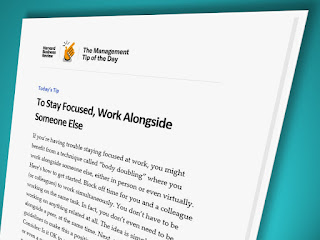
Earlier this year there was a great post in Harvard's 'Management Tip of the Day' series more or less reiterating what I have found over the years which motivates me. When we are having difficulty in keeping our attention on the tasks we are meant to be tackling, we can all benefit from a technique which is called “body doubling” (Harvard Business Review, 2022, citing Grayson Riegel, 2022). This is where we "work alongside someone else, either in person or even virtually" (Harvard Business Review, 2022).

How does this work? Well it turns out that we don’t "need to be working on anything related", or on similar tasks. It is simply about buddying-up to do the mahi, together, and we encourage each other to persevere, together. We get work done in company. Most of us like company (Harvard Business Review, 2022), and the company keeps us engaged much longer than we may do on our own.

To begin working like this, we just need to find time in your calendar where we can work with others, and think about who we might like to work with. Someone with the same type of habits as ourselves is best - if we like to rock along with music, find someone else who likes that too. If we like it quiet, ditto (Harvard Business Review, 2022).

We approach our chosen buddy - or buddies - and juggle calendars to give this a try. Before we have our first session, through, we set some ground rules. We need to think about (Harvard Business Review, 2022):

  • What do we "each intend to accomplish" in this session?
  • How do we "hope to feel by the end of [our] time" together?
  • "Is it OK to ask one another for advice, help, resources, or even a pep-talk if needed?"
  • Can we "mention when [we] notice [...]our peer [is] losing focus?"
  • "When will [we take our] breaks?"
  • "Are [we] working silently or is polite chatting permitted?"
When we finished each session, we should briefly reflect on what we got done, asking the four great questions: what went well, what can be improved, what surprised us, and what was missing. And we are supposed to "thank each other for being present, and decide if and when to do this again" which is a bit icky, but hey (Harvard Business Review, 2022).


Sam

References:

Harvard Business Review (11 March 2022). Management Tip of the Day: To Stay Focused, Work Alongside Someone Else [email]. https://hbr.org/?utm_medium=email&utm_source=newsletter_daily&utm_campaign=mtod_notactsubs&deliveryName=DM181024

read more "Body doubling"

Monday, 15 November 2021

Motivational interviewing illustrators

I think of motivational interviewing as creating change where there is currently uncertainty. It has been formally defined by the theory founders as "a collaborative conversation style for strengthening a person’s own motivation and commitment to change" (Miller & Rollnick, 2013, p. 24). To create that change, we 'nudge' our clients through the use of open, non-judgemental questions, and the use of a lot of reflection back to the client to check in with what the client is saying. I will do another post about motivational interviewing.

This time I show two old videos which still - despite their age - illustrate motivational interviewing (does the dentist reminds you of Phoebe from Friends as well?!). First we see the 'how not to do it' video, then secondly, how it could work, with nudges, while allowing the person their own autonomy.

First, watch how we may 'tell' our client what they are doing 'wrong' (MerloLab, 2009):

Second, we look instead at how we might 'ask' our client about what they are doing, allowing advice arise from a conversation (MerloLab, 2009):

This is a fascinating illustration of how motivational interviewing works.


Sam

References:

  • MerloLab (25 November 2009). The Effective Dentist: Motivational Interviewing Demonstration [video]. https://youtu.be/f8QSA_5PEFM
  • MerloLab (26 November 2009). The Ineffective Dentist: Non-Motivational Approach [video]. https://youtu.be/3xrEaFPbYC8
  • Miller, W. R. & Rollnick, S. P. (2013). Motivational Interviewing: Helping people change (3rd ed.). The Guildford Press.

read more "Motivational interviewing illustrators"

Wednesday, 20 May 2020

The pyramid scheme that was Maslow

Source: Thompkins-Jones (24 July 2014)
In 1943, a psychologist called Abraham Maslow presented a framework in a paper proposing that we humans had a stepped range of needs, called the hierarchy of needs. Maslow says in his paper that while the needs appear to be progressive, they are not equally important to individuals, and further notes that he does not want to "give the false impression that a need must be satisfied 100 per cent before the next need emerges" (1943, p. 389). He provides an example that an average person might reach "85 per cent in [their] physiological needs, 70 per cent in [their] safety needs, 50 per cent in [their] love needs, 40 per cent in [their] self-esteem needs, and 10 per cent in [their] self-actualization needs" (p. 390). And note those headings: they too have changed since Maslow wrote his original psychology paper.

Researcher John Ballard hunted through the "Maslow archives at the Center for the History of Psychology at the University of Akron in Ohio", and after an extensive and wide-ranging research programme with his fellow authors, Todd Bridgman and Stephen Cummings, "found no trace of Maslow framing his ideas in pyramid form” (2019, p. 82). They further note that up until the 1980s, the preferred model for Maslow's hierarchy of needs was a ladder, where the reader could imagine simultaneous points of contact with different rungs. This ladder framework is more in keeping with what Maslow outlines in his original 1943 paper. Maslow's ideas do not fit a pyramid.

What is also interesting is how Maslow's work transferred from psychology to management. Bridgman et al. state "Douglas McGregor [..] encountered it in 1944 and drew on it in developing his famous Theory X and Theory Y concept" (2019, p. 84). Correspondence which followed between the two academics resulted in McGregor championing the hierarchy of needs; in industry, at conferences, and publishing papers about it. McGregor's interest arose at an opportune time when returned service people were coming back from WW2 in Europe and the Pacific, and enrolling at university. The GI Bill for returned service people included fully-funded MBAs from a grateful American public.

It was McGregor who made Maslow famous, although until the early 1960s, Maslow's thinking which inspired McGregor's Theory X and Theory Y was hidden, unacknowledged, within McGregor's work (Bridgman et al., 2019). Maslow's hierarchy first appears as a demi-ziggurat image by Davis (1957, as cited by Bridgman et al., 2019), and then as a pyramid from McDermid (1960, as cited by Bridgman et al., 2019). Both of models are clearly targeting business readers, being published respectively in Human Relations in Business, and Business Horizons (Bridgman et al., 2019). Maslow is now a management hot property, complete with a shape which means change in mathematics, with the layers of the model named as physiological needs, safety, social, esteem, and self-realisation needs (McDermid, 1960, as cited by Bridgman et al., 2019). Note the changes of rung names from paragraph one.

Many elements got lost as time ticked on, such as Maslow's initial idea that people can be at many stages, all at once (1942). In a later book, Maslow talks about transcendence, which seems to imply there may be a level past that of self-actualisation (1962). Maslow also proposes that, to be healthy and to grow, humans need to use their capacities - such as striving, physiology, intelligence, and love - or potentially may suffer from either physical or psychic disease (1962). These ideas have not been reflected in the pyramid that the management field has adopted.

After the experiences of WW2, Maslow sought peace, yet we have "ignore[d] some of [his] more egalitarian principles" (MacLellan, 2019). Additionally, Maslow had some interesting ideas about women - saying about Mexican women that "one woman is about as good as another, and that she is interchangeable with others. She discovers that she is not valuable; it is the class 'woman' that is valuable" in the eyes of Mexican men (1962, p. 121). Ouch.

Maslow was a free-thinker, and his thinking probably still has value: even if we have not been able to gather research evidence that his model actually works in practice. We do, however, need to remind ourselves that his model is: (a) not a pyramid; (b) not sequential; (c) not absolute; and (d) is not a management model.

If we read what Maslow originally wrote, then it is a useful as a lens to consider what may be holding us - or others - back.


Sam

References:
read more "The pyramid scheme that was Maslow"

Saturday, 23 November 2013

Volunteering: what do we get from it?

Volunteering in New Zealand is more culturally endemic than Australia; out of 4 million people we have 800,000 volunteers. Australia with 20 million has 200,000. That's 20% of Kiwis versus 5% of Aussies (this little stat got me wondering if Aotearoa has more volunteers than other nations - but I will leave that for a later post!).

Sport NZ commissioned a study in 2006 on what drove New Zealanders to volunteer in sporting organisations. They found four key generic values of "generosity; love of sport; social connection; and appreciation" (SNZ, 2006). The nature of volunteerism - not philanthropy - is fascinating, as are the motivations to do it.

The SNZ study also explored the life stage of volunteers, and found four main volunteer clusters: late teens, 'youth', family and 'seniors'. You are most likely to be a sports volunteer if you are a Pakeha man in their 40s with a child over 18 (2007). Half of sports volunteers are in visible roles, half are ‘behind the scenes’. A quarter of people volunteer for under two hours a week, a quarter for between two and four hours. A sixth of us volunteer for more than ten hours a week.

95% of volunteers recommend the value of volunteering to others. They get a lot out of volunteering: personal satisfaction, the sense of giving something back, leaving a future legacy, helping out their own kids and love of the sport (SNZ, 2007).

But we also fall off the perch often, with some pretty regular, recurring themes. These include outside or work pressure and a "feeling that it is time to move on", and getting on with people via personality clashes and club ‘politics’ (SNZ, 2007).

So why do we fall off? Harold Levinson & some Harvard buddies (1972) did some work on motivation, based on Schein's (1970) work, suggesting we have five main motivational assumptions which drive us. They are the rational economic, the social, the self-actualising (all dervied from Schein), the pyschological (Levinson et al) and the complex (Schein again) assumptions. Hmm... actually, that last one is really a combo of any of the others. So let's dial that back to four key assumptions.
  1. Rational-economic: People are motivated primarily by economic needs. They are passive and can be manipulated, motivated and controlled by the organisation. People are irrational, and so organisations must be structured to control their feelings and unpredictable traits. 
  2. Social: People are social animals and gain their sense of identity from relationships with others. Rationalisation has taken much of the meaning out of work itself, so meaning is sought in social relationships on the job. Management must be able to mobilise and rely on social relationships, and so issues of leadership style and group behaviour are important. 
  3. Self-actualising: People are primarily self-motivated and self-controlled. They seek to be mature on the job and are capable of it. 
  4. Psychological: People are complex, unfolding, maturing organisms who pass through physiological and psychological stages of development. Work is part of a person’s identity and ego ideal, and motivation depends on having opportunities to work towards that ego ideal.
  5. Complex: People vary, with many motives whose relative importance changes from time to time and situation to situation.
The rational-economic usually doesn't apply to volunteering. But the social, self-actualising and psychological ones do (and in combination in the complex view). So when people change, when a new club captain is appointed, when we suddenly see a new way; it is easy to see how our motivational mojo can suddenly run dry.

The trick in managing a volunteer organisation is to go and have those chats with people that keep them engaged. The best volunteer people do that in spades.

He Tangata, he Tangata, he Tangata!

References:

Sam
read more "Volunteering: what do we get from it?"

Friday, 4 November 2011

Newsletter Issue 209, November 2011


Sam Young Newsletter

Issue 209, November 2011
Hi guys,
Are you motivating your staff? Check out Motivation - Intrinsic vs Extrinsic Factors  below.
We have a bit of a laugh with Peta Mathias in Motivational Cooking Advice
Don't forget, if you want to be taken off my mailing list, click here to send me a reply e-mail and I will remove your name.

Motivation - Intrinsic vs Extrinsic Factors

What motivates you?
I know for me, it is personal satisfaction from a job well done. For others it will be recognition. For some it will be challenge. For a few it will be status. For a very few, it will be money.
Richard Daft, in his book "The Leadership Experience" defines motivation as the "forces, either internal or external to a person, which arouse enthusiasm and persistence to pursue a certain course of action” (2005, p. 294). So what does that mean to a each of us?
At its most simple, motivation starts with a need that creates within us a desire to fulfil it; like friendship, food or recognition. So then we have to take action. We behave in a way results in us fulfilling our needs. So we get the rewards that we were after; and we have satisfied our needs.
However, our rewards can be either intrinsic or extrinsic. Intrinsic needs are those things that come from within; personal development, challenge, self-fulfilment, that warm fuzzy feeling of being appreciated, self-determination. Extrinsic needs come from without; recognition, status, promotions and bonuses. Recognition is an interesting factor. It impacts on both extrinsic and intrinsic motivation.
Charles Handy, in his book "Understanding Organizations" (1993), thinks that we that motivation theories can be categorised under one of three headings. Firstly there are satisfaction theories, which assume that a ‘satisfied worker is a productive worker’. Secondly there are incentive theories, which assume reinforcement is the key (this is a ‘carrot’ approach - that reward will lead to good performance - extrinsic motivation). Thirdly there are intrinsic theories, which assume individuals will work harder if they have a worthwhile job – that reward will come from satisfaction in the work itself.
However, Harold Levinson, in his manager’s views of motivation theory (1972) thought that we had a much more complicated approach to motivation. He proposed that we have four main groups, and one that is a combination of any or all of the four. They are:
  1. Rational-economic assumption – we are motivated by economic needs, passive & can be controlled by the organisation. This manager believes in extrinsic motivators (money, status)
  2. Social assumption – we are motivated by social needs, affiliation (teams; social activities)
  3. Self-actualising assumption – motivated by intrinsic needs – autonomy / goal setting rather than managerial control (goals; empowerment)
  4. Psychological assumption – work is part of our identity, our ‘ego ideal’. We need opportunities to fulfil our ‘ego ideal’
  5. Complex assumption – motivated by a combination of dynamic & ever-changing factors
There are lots of theories about how we tap into intrinsic and extrinsic motivation, but one common idea is that if someone is intrinsically motivated, that motivation lasts MUCH longer than if we try to motivate the same person extrinsically (with external rewards).
"That sounds all very good in theory,"  I can almost hear you say "but I bet people aren't really like that in the real world".
However, a recent Employee Insights survey of Kiwi workers shows that 33% of respondents say that "acknowledgement and appreciation" is what motivates them,  32% are motivated by role challenge, 23% by workmates and/or company culture, with 12% rating the dollars as a motivator.
Consultants Robert Walters NZ ran this survey for the second time this year, surveying accounting, finance, banking, management, HR, IT, procurement, supply chain, sales, marketing, secretarial and business support employees.
This means that if you are wanting to reward your staff, you need to tell them you appreciate them; that they provide value. You need to challenge them in a way that they can acheive. You need to have a healthy organisational culture and build a good team atmosphere.
It's not definitely not rocket science, is it :-)
 
References:
Daft, Richard L. (2005). The Leadership Experience (3rd Edition). USA: Thomson South-Western.
Handy, Charles (1993). Understanding Organizations. UK: Penguin
Levinson, Harold (1972) based on Schein, Edgar (1970). Organizational psychology. USA: Prentice Hall

Motivational Cooking Advice

Following on this issue's motivation theme, while laying a thick layer of newspapers in the bottom of a raised herb garden as weed matting, I noticed an unread Dominion Post Magazine from October 22. Peta Mathias had given her usual tongue-in-cheek advice to a reader who wanted to know how he could make some 'fast food' (ie, food he could prepare quickly) as often neither he nor his girlfriend could be bothered cooking.
I felt that Peta's reply was amusing enough to share with you all.
"The secret to fast food at home is to have lots of ingredients already in the kitchen - like peas, fish and pesto in the freezer; tinned tuna, sardines and ready-made curry pastes in the pantry; salami, butter and parmesan cheese in the fridge. If you've got dried pasta, olive oil and red wine, you've got a meal.
"Here's what you do: first drink a glass of wine while you're getting the other ingredients together. Next, look at the pasta and decide you can't be bothered cooking it. Next, take the olive oil, spread it all over your girlfriend, then lick it all off again. This is a very nutritious meal, satisfies two people and you will never complain about being unmotivated again."

Reference: Mathias, Peta (22 October 2011). Your Weekend Magazine. NZ: Dominion Post (p. 5)


How to Hyphenate Words

The Oxford English Dictionary's October newsletter contained a useful little 'how to' on the rules for hyphenation.
  1. We DON'T link 'phrasal verbs' using a hyphen. Phrasal verbs are verbs made up of a main verb together with an adverb or a preposition (or both). The meaning is usually not obvious from the individual meanings of the words. For example "I made up my tie "; 'made' and 'up' forms the phrasal verb.
  2. However, we DO link nouns that are made up of phrasal verbs. You would buy a 'made-up' tie.
  3. We also use hyphens when they clarify our meaning. For example: "There will be extra trains, including more late-night trains" makes sense, whereas "There will be extra trains, including more late night trains" could mean that the night trains were simply late.
So just ask yourself; is this a noun that I am hyphenating? And does it clarify sentence meaning? ... and if in doubt, leave it out :-)


TLAs for SMEs

Here are this newsletter's TLAs (Three Letter Acronyms) for you:
  • UNA, Use No Acronyms. I thought that was cute!

Please feel free to email me with any TLAs that you want to get the bottom (meaning!) of.

Tips, Short+Hot Keys
In this newsletter, we look at all you can do in Publisher with Page commands:
  • Publisher "Move down within a page or scroll down in the Help pane" Page Down
  • Publisher "Move up within a page or Scroll up in the Help pane" Page Up
  • Publisher "Scroll to the left" Ctrl & Page Up
  • Publisher "Scroll to the right" Ctrl & Page Down

Hot Linx
While we assume that creating the right kind of atmosphere at work should be common sense, we often don't act like we understand what common sense is. Check what is productive at http://www.stuff.co.nz/business/industries/5847549/Creating-a-productive-workplace
Read this HBR article on four ways women unintentionally sabotage their career prospects - overly modest, not asking, fitting in, keeping quiet - is fascinating at http://blogs.hbr.org/cs/2011/10/four_ways_women_stunt_their_careers.html?utm_source=twitterfeed&utm_medium=twitter
Check out what Sir Paul Callaghan has to say in a 20 minute speech entitled "StrategyNZ: Mapping our Future" that was delivered in March 2011 at http://www.youtube.com/watch?v=OhCAyIllnXY
Kelly Eggers of the Wall Street Journal looks at the ten worst mistakes made by Uni graduates when looking for their first professional position in this article at http://www.fins.com/Finance/Articles/SBB0001424052970204226204576601420036627098/The-10-Worst-Mistakes-of-First-Time-Job-Hunters

                                Catch you again soon!! E-mail your suggestions to me here
read more "Newsletter Issue 209, November 2011"