Pages

Showing posts with label Internet. Show all posts

Friday, 1 May 2026

A few interesting nuggets

In researching material for recent post (here) I found a few interesting nuggets (side-projects, if you will). The first tip I heard was a second recommendation for the Cory Doctorow book on internet 'enshittification' (McBain, 2025, commenter "hureharehure"; Skopic, 2025). This was noteworthy because I tend to use only three platforms regularly: following a number of makers on YouTube; posting to LinkedIn, and a very minor storefront on BlueSky. Twitter, FB, Insta etc all feel too skewed (Wylie, 2019) and full of that 'enshittification' which Cory Doctorow appears to explores in his book (Skopic, 2025). So that is a definite reading list inclusion, and I have put in a request for the title at the library.

Second, the enshittification of the interweb is making me think more seriously about reading Sarah Wynn-Williamson's book on Facebook. I was reluctant, because her time at FB is now quite dated, but I am now thinking that I should read it. Shaping forces, and all that. I have also put in a library request for this one as well (but there is a LONG waiting list!).

And third, commenter hureharehure also helpfully suggested that if readers were unable to "read some of those links directly [we...] will likely be able to find archived versions with a site like https://archive.ph/" (McBain, 2025). Wow! The Archive.Today site was one I had not previously heard of, so I have banked that very helpful suggestion... and already used it several times to great effect to read articles which are behind paywalls. 

I will do some book reviews once I have read and digested the books :-)


Sam

References:

Archive.Today. (2026). Webpage Capture and Article Finder. https://archive.ph/

McBain, S. (2025, October 18). Are we living in a golden age of stupidity?. The Guardian. https://www.theguardian.com/technology/2025/oct/18/are-we-living-in-a-golden-age-of-stupidity-technology

Skopic, A. (2025, August 22). Why the Internet is Turning to Shit. Current Affairs. https://www.currentaffairs.org/news/why-the-internet-is-turning-to-shit

Wylie, C. (2019). Mindf* ck: Inside Cambridge Analytica’s plot to break the world. Profile Books.

Wynn-Williams, S. (2025). Careless People: A cautionary tale of power, greed, and lost idealism. Flatiron Books.

read more "A few interesting nuggets "

Monday, 20 April 2026

Search and AI brain rot

A recent post was about some research on the lack of brain activity when using AI tools (here; Kosmyna et al., 2025; McBain, 2025). What I also found some interesting user comments generated by the article (McBain, 2025). One, by a tutor/teacher, said that "that Googling an answer does provide knowledge [...as] long as the answer provided is the correct one" (commenter "bettycallmeal", McBain, 2025). While I would suggest that bettycallmeal may have meant 'information', rather than "knowledge", I understood the gap she was seeking to bridge for her students between search and the necessary injection of critical thinking to sift the grain from the dross.

One search solution I use is to avoid Google as much as I can, part of Alphabet's empire. I avoid Google - and Chrome - most of the time because of Alphabet's profit motive. Google is a business, collecting my cookies to track my online movements, feeding me ads designed to get me to buy, and selling my search data, and skewing my search results towards its clients, and to previous user search results in my area. It is now what they 'do'. I am not annoyed at a business being true to its nature, but I do not like constantly being marketed to/at. 

Instead, I sought out a search engine which had privacy at its core, and went with DuckDuckGo. DuckDuckGo aims "to protect the privacy of its users", and returns "the same search results for a specific keyword, without filtering those search results and personalizing them based on the [user's] history [to] the user" (Tyrsina, 2025). While I get fewer search results, often - not always though - those results are more accurate. Additionally, I use the Brave browser which while built on the Chrome platform, still slashes tracking cookies and advertising on my PC. On my mobile I use DuckDuckGo and Adblock browser. Those tools might also help bettycallsmeal's students.

But the problem is probably larger than just where we search. Another commenter (commenter "hureharehure", McBain, 2025) replied to bettycallmeal that another complication was that "the internet [...] is eating itself" - a timely reminder of the oroboros! - due to "much of the internet [now being full of] AI slop". It appears that many media platforms allow unreliable AI generated material to proliferate (read more here). Commenter hureharehure had found users to be "quite incurious about whether the information they seek is at all reliable" and pointed bettycallmeal to the following resources to assist her students (McBain, 2025):

  • Users seeing the "AI-generated summary on Google search are significantly less likely to click on external links than users who don't" (commenter "hureharehure", McBain, 2025), with only 1% of users clicking on AI summary links (Chapekis & Lieb, 2025). Since Google’s AI Overviews launched in May 2024, 69% of Google news searches have users not clicking on any links, up from 56% (Barenholtz, 2025; commenter "hureharehure", McBain, 2025). So why is that, then?
  • Well, because it appears that Google's AI summaries are giving people just enough information so they don't need to know more (Jaźwińska, 2025). Though I must confess, if I get a news article summary and it is on a platform I am subscribed to, I won't click through on a Google News link: I will go straight to the platform so it lowers the platform's Google bill
  • Apparently nearly a billion people already use ChatGPT (The Economist, 2025); we are not talking all the other LLM platforms through, such as Deepseek, Claude, Gemini, Copilot, Perplexity, and SciSpace for language work; Reclaim and SkedPal for planning; Midjourney, Dall-E, Firefly and Deep for images; Veo, Runway, Sora and Synthesia for video; Asana for calendar work (Karkar, 2025)
  • Read an exploration of the "dead internet theory" (Prada, 2025) and a summary of platform slop, advertising and AI hallucination (Goodfriend, 2025; Koebler, 2025)
  • Get a review of the forthcoming book by Cory Doctorow on internet 'enshittification' (Skopic, 2025)

These are things we should be telling our students, so they realise that any search is not necessarily a 'good' search. It may be a skewed search: for example, Google/Gemini AI search and summaries are likely to be skewed based on location search history, our national laws, local businesses who have Google Ad Words, and the data that has been fed into Gemini (Gleason et al., 2023). 

If our students are not using their critical thinking skills but accepting what search has delivered up to them, then "Houston, we have a problem" (Howard & Graze, 1995, 50:52): and the research appears to already be showing that problem. Our less critical thinkers seem to be already experiencing brain rot (Karunaratne & Adesina, 2023; Kosmyna et al., 2025; McBain, 2025). 

To me, more AI use seems unlikely to improve critical thinking skills, but to reduce them. And that is a serious problem. 


Sam

References:

Barenholtz, L. (2025, March 12). Google AI Overviews: SEO Tips and Strategies. Similar Web. https://www.similarweb.com/blog/marketing/seo/ai-overviews/

Chapekis, A., & Lieb, A. (2025, July 22). Google users are less likely to click on links when an AI summary appears in the results. Pew Research Center. https://www.pewresearch.org/short-reads/2025/07/22/google-users-are-less-likely-to-click-on-links-when-an-ai-summary-appears-in-the-results/

Gleason, J., Hu, D., Robertson, R. E., & Wilson, C. (2023, June). Google the gatekeeper: How search components affect clicks and attention. In Proceedings of the International AAAI Conference on Web and Social Media (Vol. 17, pp. 245-256). https://ojs.aaai.org/index.php/ICWSM/article/download/22142/21921

Goodfriend, D. (2025, July 10). Deadly Slop: Artificial intelligence on the battlefield. The Baffler. https://thebaffler.com/latest/deadly-slop-goodfriend

Howard, R. (Director), & Grazer, B. (Producer). (1995). Apollo 13 [motion picture]. Universal Studios.

Karkar, J. (2025, August 21). 29 Top AI Platforms to Look Out for in 2025. TestGrid. https://testgrid.io/blog/top-ai-platforms/

Karunaratne, T., & Adesina, A. (2023, October). Is it the new Google: Impact of ChatGPT on students’ information search habits. In Proceedings of the 22nd European Conference on e-Learning, ECEL (pp. 147-155). https://www.researchgate.net/profile/Thashmee-Karunaratne/publication/374911381_Is_it_the_new_Google_Impact_of_ChatGPT_on_Students%27_Information_Search_Habits/links/6589f3110bb2c7472b0fc0d8/Is-it-the-new-Google-Impact-of-ChatGPT-on-Students-Information-Search-Habits.pdf

Jaźwińska, K. (2025, July 31). Traffic Apocalypse: Google’s AI Overviews are killing click-throughs to news sites. Colombia Journalism Review. https://www.cjr.org/analysis/traffic-apocalypse-google-ai-overviews-killing-click-throughs-news-sites.php

Koebler, J. (2025, July 15). The Hyperpersonalized AI Slop Silo Machine Is Here. 404 Media. https://www.404media.co/the-ai-slop-niche-machine-is-here/

Kosmyna, N., Hauptmann, E., Yuan, Y. T., Situ, J., Liao, X. H., Beresnitzky, A. V., ... & Maes, P. (2025). Your brain on ChatGPT: Accumulation of cognitive debt when using an AI assistant for essay writing task. arXiv. Advance online publication. https://arxiv.org/abs/2506.08872

McBain, S. (2025, October 18). Are we living in a golden age of stupidity?. The Guardian. https://www.theguardian.com/technology/2025/oct/18/are-we-living-in-a-golden-age-of-stupidity-technology

Prada, L. (2025, September 15). One-Third of the Internet Is Just Bots Now. Seriously. VICE. https://www.vice.com/en/article/yep-one-third-of-the-internet-is-just-bots-now/?

Skopic, A. (2025, August 22). Why the Internet is Turning to Shit. Current Affairs. https://www.currentaffairs.org/news/why-the-internet-is-turning-to-shit

The Economist. (2025, July 14). AI is killing the web. Can anything save it?.  https://www.economist.com/business/2025/07/14/ai-is-killing-the-web-can-anything-save-it

Tyrsina, R. (2025, October 10). What is DuckDuckGo and what are the benefits of using it?. Digital Citizen. https://www.digitalcitizen.life/what-is-duckduckgo/

Wylie, C. (2019). Mindf* ck: Inside Cambridge Analytica’s plot to break the world. Profile Books.

Wynn-Williams, S. (2025). Careless People: A cautionary tale of power, greed, and lost idealism. Flatiron Books.

read more "Search and AI brain rot"

Wednesday, 1 April 2026

The parasocial experience

In watching a conference presentation from cardiology surgeon and stand up comedian, Dr Rohin Francis, he mentioned a term new to me: that of the parasocial relationship (CEBM Oxford, 2025). So I went to look up what that meant.

Originally, we had two components: the parasocial relationship or PSR, which is "the illusion of intimacy with media" figures; and parasocial interactions or PSI, the "sense of a give and take [we may think we have] with the media figure" (Forster, 2023, p. 1, Horton & Wohl, 1956). Today we tend to refer to the parasocial experience or PSE as one thing, or an "imaginary, one-sided engagement of audiences with media personalities" (Forster, 2023, p. 1). It is fascinating that the research on parasocial relationships (Horton & Wohl, 1956) seems to have begun in the television age, but perhaps it was more that the US post war 'golden age' of industrial psychology was gaining a head of steam.

The antithesis of PSE is the social experience... where we interact in person with real people in real time. Where we rock up, warts and all, and have an uncurated, un-Googleable, un-undoable experience. PSE has grown from its formalisation as a concept by Horton and Wohl (1956) of perhaps watching a news reader on TV; however it also includes being an audience observer of "actors (in person) in theater; [and] reading about fictional characters in novels; [and] watching live streamers on social media; and even relating brands and websites as a whole" (Forster, 2023, p. 4). So much of life is a PSE. A book. A sound file. A TV show. A film. A painting. So might a lecture be a PSE, as often we may not have an in-person interaction with a lecturer (Forster, 2023).

Anywhere we can't be in person, but can bank the experience to catch up on later: Zoom recordings or DVDs are PSEs. But then we get into the tricky position of trying to decide if a phone call or a Zoom call is a PSE or an SE. Or is this a blend? We are not in person, but we are interacting in real time. The blending of the virtual and the real makes the boundaries of the terms fuzzy.

I think we can also lose sight that we have had fan-boy/girl reactions to celebrities since forever. PSE is not a purely modern social media thing. We have had PSEs prior to TV as well, with kings, preachers, peacemakers and warriors: Odysseus; Hannibal; Boudica; Joan of Arc; Peter the Great; Queen Victoria; Ghandi. TV made them more accessible; and digital media more accessible still. 

But at least we all now know what a PSE is :-)


Sam

References:

CEBM Oxford. (2025, September 22). The wacky world of wellness-influencer-to-consumer communication - Dr Rohin Francis [video]. YouTube. https://youtu.be/lXZh9B_ADko

Forster, R. T. (Ed). (2023). The Oxford Handbook of Parasocial Experience. Oxford University Press.

Horton, D., & Wohl, R. (1956). Mass communication and para-social interaction: Observations on intimacy at a distance. Psychiatry, 19(3), 215-229. https://doi.org/10.1080/00332747.1956.11023049

read more "The parasocial experience"

Monday, 30 March 2026

AI does rot the brain

While I have written about AI before (here), there is research showing that regular use of LLM apps - such as Claude.ai and ChatGPT - appears to reduce our brainpower. In a small experiment designed to see if we 'lose it' if we don't 'use it', participants were divided into three groups of 18, tasked with writing a piece "with[out] digital assistance, or with the help of an internet search engine, or [with] ChatGPT" (Kosmyna et al., 2025; McBain, 2025). There have been previous studies (Kosmyna et al., 2025, citing Stadler et al., 2024), and this paper had a limited number of student participants - a group of 54; we probably need to do a few more studies to firm things up.

Regardless of participant numbers, the findings seem relatively unambiguous. Using EEG to track cognitive engagement and load (Kosmyna et al., 2025), results indicate "that the more external help participants had [for their writing task], the lower their level of brain connectivity, so those who used ChatGPT to write showed significantly less activity in the brain networks associated with cognitive processing, attention and creativity" (McBain, 2025). Through a a process known as "cognitive offloading", results indicate that increased use of "AI systems [...] lead[s] to diminished prospects for independent problem-solving and critical thinking", which in turn "raises concerns about the long-term implications for human intellectual development and autonomy" (Kosmyna et al., 2025, p. 10).

The findings are worrying, especially as secondary school students seem to use AI/LLMs a LOT. Tertiary institutes are still trying to hold back the tide on AI use... for now. With these research results, this strategy seems imminently sensible, as "excessive reliance on AI-driven solutions" seems to "inadvertently contribute to cognitive atrophy" (Kosmyna et al., 2025, p. 10). Ouch. That is pretty damning.

I know of people who regularly use LLMs for work tasks. They outsource their emails to an LLM; the text to frame their quotes; their first draft contracts; policy; procedure; and other writing. But, as I have mentioned before (here), writing, composition, clarity of thought and expression of argument are learned expertises, or "time skills" (Canning, 1975), “where the ticking away of the unforgiving seconds plays a dominant part in both learning and application of the skill” (p. 277). Like driving, we cannot contract it out to others and expect our skills to improve without that continuous practice. Our old skills will grow rusty from disuse, and we will have to retrain to some level to reclaim what has evaporated through atrophy.

Of course, these results may be a knee-jerk reaction to the 'new'; over-blown drama that will evaporate like dew as the field progresses. We may simply be replacing one skill for another. 

Only time will tell.


Sam

References:

Canning, B. W. (1975). Keyboard skill-a useful business accompaniment. Education + Training, 17(10), 277-278. https://doi.org/10.1108/eb016409

Kosmyna, N., Hauptmann, E., Yuan, Y. T., Situ, J., Liao, X. H., Beresnitzky, A. V., ... & Maes, P. (2025). Your brain on ChatGPT: Accumulation of cognitive debt when using an AI assistant for essay writing task. arXiv. Advance online publication. https://arxiv.org/abs/2506.08872

McBain, S. (2025, October 18). Are we living in a golden age of stupidity?. The Guardian. https://www.theguardian.com/technology/2025/oct/18/are-we-living-in-a-golden-age-of-stupidity-technology

read more "AI does rot the brain"

Monday, 20 January 2025

So what is slop then?

If you haven't heard of "slop" yet, I am sure you have seen it. Slop is AI generated crap, according to the 'founder' of the term, Simon Willison (Hern & Milmo, 2024). Think religious characters with lobster arms (Hern & Milmo, 2024; see image accompanying this post). Think people with ten fingers and dissolving faces. Think truckloads of babies (Rawhiti-Connell, 2024; see image accompanying this post). Slop. Using lots of generative AI computing power, even the least creative amongst us is able to create "low-quality content [...with a few commands which] allow[s] anyone who don't know a thing about the art to create their own slop" (Zhou et al., 2024, p. 5). Rawhiti-Connell compares the apparently run-away generative AI slop on Facebook to a hydra, where FB's policing people on minimum wage "cut off one head, [only to have] two more ads about witnessing your brother’s best friend masturbating appear" (2024).

Slop "isn’t interactive, and is rarely intended to actually answer readers’ questions or serve their needs. Instead, it functions mostly to create the appearance of human-made content, benefit from advertising revenue and steer search engine attention towards other sites" (Hern & Milmo, 2024). A proxy for interaction, then. What is really interesting is that I don't think answering questions, serving needs or creating interaction was ever the reason for social media: it was always generating money through advertising placement. As Rawhiti-Connell says, we, the grazing herd, "are the product" (2024). 

Meta, dubious owner of equally dubious Facebook, reported the removal of "631 million fake accounts globally in the first quarter of 2024" for creating fake news stories related to celebrities: known as 'Celebcore' (Rawhiti-Connell, 2024), which is also slop. Crap that is all pixels and no actual content, created by generative AI to look like news, but to not actually be news. Apparently FB has become so rife with AI slop that it is turning into an AI ghost town (Rawhiti-Connell, 2024): but I have no personal knowledge of this as I left FB after the 2017 Cambridge Analytica scandal. It appears that social media platforms are increasingly full of "ads, and now, the plague-like sprawl of fake posts, bot-farmed engagement and meaningless imagery" with drivers to engagement being "outrage and anger" (Rawhiti-Connell, 2024). We really are sparking some useful emotions here :-)

Social media always was a "pseudo connection", but it is becoming more so as the clock ticks on. The "lucrative advertising business [of FB] sits flush alongside its transformation from a digital hub of genuine social interaction to a chaotic landfill of misinformation and AI-generated freak shows" (Rawhiti-Connell, 2024).

So I wonder what will happen when social media platforms are so full of slop that people stop coming to look at the ads?


Sam

References:

Hern, A., & Milmo, D. (2024, May 19). Spam, junk … slop? The latest wave of AI behind the ‘zombie internet’. The Guardian. https://www.theguardian.com/technology/article/2024/may/19/spam-junk-slop-the-latest-wave-of-ai-behind-the-zombie-internet

Rawhiti-Connell, A. (2024, July 9). Fake news, AI slop and little human connection: What is Facebook these days?. The Spinoff. https://thespinoff.co.nz/internet/09-07-2024/fake-news-ai-slop-and-little-human-connection-what-is-facebook-these-days

Zhou, K. Z., Choudhry, A., Gumusel, E., & Sanfilippo, M. R. (2024). "Sora is Incredible and Scary": Emerging Governance Challenges of Text-to-Video Generative AI Models. arXiv, Advance online publication. https://arxiv.org/pdf/2406.11859

read more "So what is slop then?"

Friday, 12 July 2024

Krug's approach to web design

The first time I heard about Steve Krug's internet design principles was quite recently in a Simon Whistler video about the history of YouTube: "YouTube did one thing that set them apart from all the others at every level, from Creator to viewer, they adhered to Steve Krug's famous design principle of 'Don't Make me Think'" (Today I Found Out, 2023, 14:21).

Hah. Who is this Steve Krug? I headed off to the library to find out.

It turns out that Steve Krug wrote a fairly seminal book on web design back in 2000 called "Don't Make Me Think", which was updated and re-released in 2014. I got a revised edition and had a scroll through.

The key piece of advice to designers is that "When you’re creating a site, your job is to get rid of the [user's] question[s]" before they even know they have questions (Krug, 2014, p. 13). To make sites so intuitive to use; buttons, links and directions so clickable that users do not stumble in navigating the site. Yes: intuitive usability is a KEY piece of good design. 

Further, it is noted that users "don’t like to puzzle over how to do things" (p. 15), and that a build up of distractions where we can't work out how we got to where we ended up will "erode our confidence in the site and the organization behind it" (p. 15). Ouch. 

This book is considered by many a seminal text in web user design (da Silva Leite, 2021), noting that elements which assist "the User Experience [are to] take advantage of conventions, create effective visual hierarchies, break the pages up into clearly defined areas, make it obvious what is clickable, eliminate distractions, format content to support scanning" (p. 14). None of this is rocket science, but it is surprising how often those cues are not clearly delivered to the user.

This book, while old, is still useful. Check it out.


Sam

References:

da Silva Leite, J. R. G. (2021). Advantages of Using User Experience Design Concepts in the Creation of E-Learning Courses. [Master's thesis, University of Lisbon]. https://repositorio.ul.pt/bitstream/10451/48201/1/ulfpie054300_tm.pdf

Krug, S. (2014). Don't Make Me Think: A common sense approach to web and mobile usability (Revised ed.). Pearson Education.

Today I Found Out. (2023, November 18). What was the First YouTube Video and How Did YouTube Start? [video]. YouTube. https://youtu.be/7GC9v-EYcsQ

read more "Krug's approach to web design"

Friday, 10 June 2022

Internet metaphors

It is always great to attend a conference. I think one of the most valuable things is that we get to hear people who don't think about the world in the same way that we do, who tell our stories from a different perspective.

I attended the CERIC (Canadian Education and Research in Career Counselling) CANNEXUS conference earlier this year, and listened to a session by Tristram Hooley and Tom Staunton (Hooley & Staunton, 2022). Their presentation was based on their book chapter in the Oxford Handbook of Career Development (Robertson et al., 2021), which outlined a number of things about the pros and cons of technology use in career development.

They outlined that the internet is not inherently good or bad. It is simply a thing. Our construction - and our client's construction - is what colours our view. An element within the presentation that was really sticky for me was their metaphor approach for the internet. They outlined six (Hooley & Staunton, 2022):

  1. Library. Collectively the internet is an information store that we - and our clients - can use for good quality career decision-making. While what is found on the web is not necessarily accurate, complete, or unbiased, it is available; providing we can give our clients appropriate tools to "interrogate, critique, and assess the value" of it (Hooley & Staunton, 2021, p. 301).
  2. Media channel. Help clients to narrow-cast their narrative/identity meaningfully so they keep "control their self-presentation online" to their own level of comfort (Hooley & Staunton, 2021, p. 301). Guide clients in narrative-development to build a positive, not negative, career identity (Hooley & Staunton, 2022).
  3. Surveillance camera. Check in to ensure clients understand traceability and permanence online. All "online [...material] can be used in a selection [, ...] management process", education, or in government records (Hooley & Staunton, 2021, p. 302). Further, just the idea of visibility may change our behaviour "to conform to what [we] imagine employers and others would want" (p. 302).
  4. Marketplace. The web is a virtual career opportunity market, created through interactions with employers, educators, recruiters, and online professional profiles such as Linkedin. It also provides volunteer project involvement to showcase skills (such as Wikipedia, Ubuntu, etc) or to advertise piece work on platforms such as Fiverr (Hooley & Staunton, 2022).
  5. Meeting place. The web enables us to have conversations with others and find our digital tribe, "build[ing] and maintain[ing] a career-relevant network (Hooley & Staunton, 2021, p. 302). This is not limited to professional networking (i.e. LinkedIn), but may include vloggers on YouTube, Facebook groups, or any of the myriad of other platforms and spaces (including the dark web for some fields).
  6. Arena. The internet enables "norms [to] be established or challenged" (Hooley & Staunton, 2021, p. 302), which is a pretty powerful idea. It also allows those in power to deny public access to the channel (such as in Syria, Myanmar, and - at times - China). The internet may be either "a place of play and exploration [or] a place of protests and critique" (Hooley & Staunton, 2021, p. 302). From the "hashtag activism" of #MeToo to "us[ing] the crowd as a form of protection", the internet is allowing us to evolve the idea of work, and to spread new ways of working and connecting (Hooley & Staunton, 2021, p. 302-3).

Quite a useful list to consider client's points of view from, and to provide useful redirect where an overly positive or negative view is taken.


Sam

References:

Hooley, T., & Staunton, T. (2022). The Role of Digital Technology in Career Development [video]. CANNEXUS22 Virtual Conference 25 January - 5 February. https://cannexus22.gtr.pathable.com/meetings/virtual/9WtH6q3KTzhfGw44R

Hooley, T., & Staunton, T. (2021). Chapter 21: The Role of Digital Technology in Career Development. In P. J. Robertson, T. Hooley, P. McCash (Eds) The Oxford Handbook of Career Development (pp. 297-311). Oxford University Press.

read more "Internet metaphors"

Wednesday, 22 December 2021

Can't log in to Hotel Wifi

Travelling. It can be fun, but if we are travelling for work, and can't get onto the hotel Wifi, travelling can suddenly turn into a 'grit the teeth' time. You know, when we go to log in, we find the Wifi, we connect, and our laptop opens a blank browser page so we can enter our log in details and accept the terms and conditions... and nothing else happens. We keep getting a blank page, and no connection. Our Wifi may say we are connected, but we are not. We refresh, we reconnect, we disconnect, we 'forget' the network... and nada.

I am not sure why, but I rarely have difficulty logging on to hotel Wifi using my phone: it is just my laptop that drives me mental. I have used the 'logout.gg' in the past to great effect (here), but this doesn't always work.

However, a helpful Reddit poster (Markhyo, answering Doorhingetedman, 2016) provided me with some advice, although the steps that get us to get the information have changed. Try the following:

  • Find and 'Connect' to the Wifi network
  • Click on the network Properties hyperlink. This will open the network settings pane.
  • Scroll down to the 'Properties' section.
  • Scroll down to the 'IPv4 Default Gateway'. The address will look something like this: 172.xxx.x.x (see image accompanying this post).
  • Copy the IP number and enter it into the browser.
This should take us to the hotel's Wifi's terms and conditions page, so we can sign in.


Sam
  • Reference: Doorhingetedman (2016). Can't connect to Hotel wifi - sign in page doesn't appear. https://www.reddit.com/r/Surface/comments/4i7bbd/cant_connect_to_hotel_wifi_sign_in_page_doesnt/
read more "Can't log in to Hotel Wifi"

Monday, 11 December 2017

Data Never Sleeps 5.0

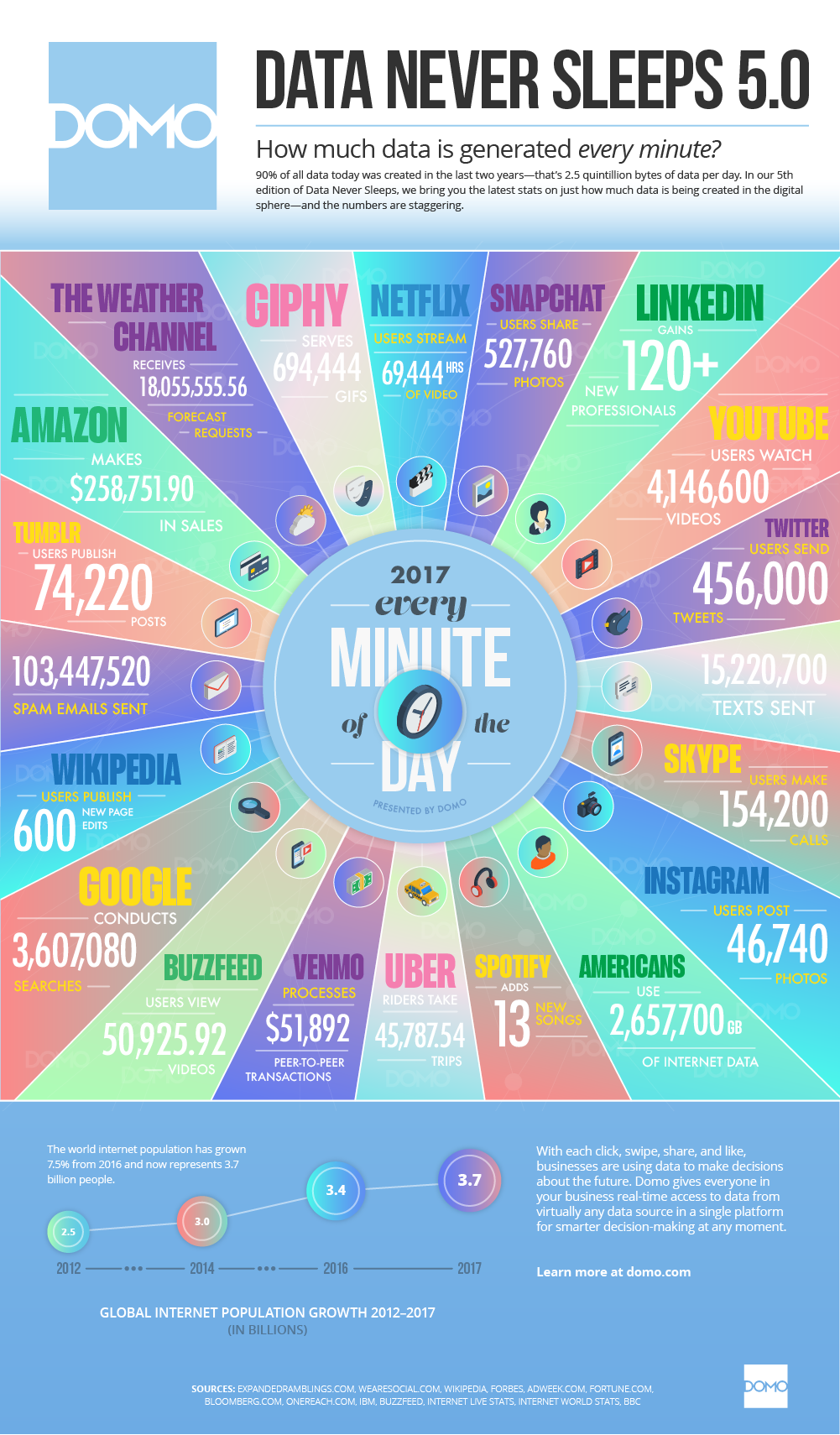
Following on from last year, Domo has once more published internet consumption / generation / creation data by the minute. The sum of digital creativity produced every sixty seconds on the planet is staggering - and continues to increase annually.

For example, YouTube viewers watched over 4 million videos in a minute this year; while last year watched 300 hours per minute, and two years ago 72. This year, 456,000 tweets sent in a minute, compared to 347,222 in 2016 and 277,000 in 2015. Pinterest pins don't feature this year, yet last year, 9,722 items were pinned per minute, and two years ago 3,472.

Here is Domo's video of the process:
To view Domo's infographic in full, click here.

What is interesting this year is that, this year, the internet has started to permeate the real world. Domo is now documenting Gbs of data consumed, texts sent, spam email and Uber trips taken.

I think we are finally starting to see the effects of The Internet of Things in real time.


Sam
read more "Data Never Sleeps 5.0"

Wednesday, 21 December 2016

Data Never Sleeps 3.0

Domo has published internet consumption / generation / creation data by the minute for the past couple of years. The sum of digital creativity produced every sixty seconds on the planet is staggering - and increasing year on year.

For example, Pinterest pins for Data 2.0 were 3,472; for 3.0, 9722. YouTube video was 72 hours; now 300. 277,000 tweets became 347,222.

infographic

Sam
  • Reference: DOMO (2015). Data Never Sleeps 3.0. Retrieved 5 June 2016 from https://www.domo.com/blog/2015/08/data-never-sleeps-3-0/
read more "Data Never Sleeps 3.0"

Monday, 21 November 2016

Viewing code on webpages

Sometimes we want to be able to view the code on web pages. the easiest way to do view a web page's source code is to key Ctrl & U. If that doesn't work, we can usually right click and select "View page source" from the pop-up menu.

However, sometimes web designers like to disable our ability to view their code, so neither Ctrl & U nor the pop-up menus work (if you have an old version of Internet Explorer, you should find that Ctrl & U will work despite any restrictions that web designers have implemented).

If you use Firefox, there is an alternative solution to force pages to cough up how they run. All you need to do is to:
  • Copy the URL of the page you want to view the source code on
  • Open a new tab
  • In the new tab address line, key "view-source:", then paste the URL directly afterwards
  • The Tab will now show the page's source code, like the image above.
This can be particularly useful when you are wanting to link to a particular file, or simply to explore how a designer has created a particular look or effect.

Sam
read more "Viewing code on webpages"

Friday, 5 April 2013

Newsletter Issue 233, April 2013


Sam Young Newsletter

Issue 233, April 2013
Hi guys,
Are we likely to see The Death of Print sometime soon? Read on below.
Is your PC or laptop fit for the job ahead? or do need to go undertake the Seven Tips for a Faster PC
Don't forget, if you want to be taken off my mailing list, click here to send me a reply e-mail and I will remove your name.

The Death of Print?

A Mashable (http://mashable.com/2013/01/16/e-books-vs-print/) article by Josh Catone in January this year cited some stats on ebooks, relating for the first time, in 2011, that ebook sales outperformed print; with ebooks increasing the performance gap in 2012. A Texas library announced plans for the US's first solely electronic library. Scholastic did a study on children's' ebook habits, with almost half of all kids aged 9 to 17 having read an ebook, and the number who said they will continue to read print books rather than ebooks declined from 66% to 58% (http://mediaroom.scholastic.com/kfrr). 
Bit of a trend happening then.
Now I love books. I am so enamoured with the written word that I suffer withdrawal symptoms if I can't get my word-fix. I have been known to read toilet roll packets and the contents of the pantry if a dearth of books unexpectedly occurs. A small stack of paperbacks has always accompanied me on trips overseas.
However, over the past five years, I have bought more ebooks and talking books than printed books. My textbooks I prefer to get as pdfs or Kindle versions, so that they become searchable. Talking books I prefer for light reading and non-fiction, because I listen to them on my nano. For the first time two years ago I went overseas without a printed book. I survived three weeks with only my nano and Kindle (actually, I had one relapse and borrowed a book from my husband's cousin - but only because it looked interesting and I hadn't read it!).
I have probably have a couple of thousand books, so we are not talking about someone who only has three tatty paperbacks on the spare room bookshelf. I am a collector of - my favourite - printed words. But more and more, the print books I buy are special books - almost art pieces - that I intend to keep, or books to continue building my favourite author collections, usually in hardback.
There is some talk already about print books eventually becoming an expensive niche product like vinyl records: crafted artisan collectors pieces... and I can see the day coming where whether a book is published in hardback or paperback will depend on audience pre-orders for that particular author. 
Apparently Readers' Digest's parent company has filed for "Chapter 11" bankruptcy in the US. Even they can't make money, with all their ads plastered around inboxes and mailboxes around the planet. I think it is harder getting off their mailing list than anyone else's.
In an article by Daniel Gross in February this year (http://www.thedailybeast.com/articles/2013/02/05/the-death-of-print-buildings.html), he noted that three US newspaper buildings - housing collectively the Washington Post, the Detroit Free Press, the Detroit News, the NY Democrat and the NY Chronicle - are to be sold. Gross notes that newspaper advertising income has halved in the past ten years, and is now level-pegging with 1983 $, with circulation falling to 1996 levels. Papers are selling off assets at an alarming rate. Journos are being cut. Newspaper content is being increasingly mashed, is advertorial or is press release content. Increasing use of free online news services is also taking revenue from the papers: fewer people are buying a paper.
Some papers have decided they will become purely online, such as the Seattle Post-Intelligencer. The NY Times has tried to reverse the revenue drain by putting their content behind a paywall, but only time will tell whether people will continue to pay for news that can be picked up freely elsewhere. The last time the NY Times tried this, their revenues took such a dive they had to do a U-turn, so it will be interesting to see if the time has come.
I now get my news from Pulse. It is a news accumulating ap (http://www.pulse.me/about/) that picks up loads of different news-feeds based on what I am interested in, and gives me a range of shorts that are very easy to pick up the key ideas from. I can then mine more deeply for things that catch my eye. No more print newspapers for me: I like things to be searchable, and loathe having to get rid of all that paper afterwards. I keep pestering the magazines I get for ezines. Takes so much less room, and the articles are accessible forever on my PC.
A shake-up in the entire printing industry seems pretty certain. How great it will be, and how much material will just segue into new formats will remain to be seen.
The one thing I am absolutely sure of is that I will never be short of something to read :-)

More reading:

Seven Tips for a Healthier & Safer PC

With winter nearly upon us, the change of season usually prompts us to think about health in all matters. That also means thinking about running through a few health checks on your PC to ensure its WOF is up to date.
My suggested list of maintenance checks, largely thanks to WindowsSecrets, are: 
  1. Backup your data REGULARLY. Download Microsoft's SyncToy 2.0 from http://www.microsoft.com/en-nz/download/details.aspx?id=15155, set up folder pairs with your removable hard drive  and regularly run (weekly is generally recommended).
  2. Temp files. Delete all your temp files. This is really easy - go to http://windows.microsoft.com/en-nz/windows-vista/delete-files-using-disk-cleanup and follow the instructions. 
  3. Empty Recycle Bin. Clean out the rubbish from time to time. Makes the house smell fresh :-)
  4. Defrag. defragging is still good maintenance in all versions of Windows - run it after you have done the first three steps. Windows defragmentation utility — defrag.exe — is adequate in XP, moderately good in Vista, and more refined in Win7. Vista’s and Win7's Task Scheduler automatically runs defrag.exe weekly during system-idle times, determining whether defragging is needed by estimating the percentage of fragmented files. If fragmentation is low, it skips 'til the next  week. A percentage in the high single digits or greater should trigger automatic defragging. However, you can verify that it’s working properly by entering defrag.exe in the search field above the start button in Windows 7.
  5. Antivirus. AVG is still a great free piece of anti-virus software for private use. Download it from http://download.cnet.com/AVG-AntiVirus-Free-2013/3000-2239_4-10320142.html. Ensure you download all the updates, and run it regularly. I have used this on my home PC for fifteen years without one single infection.
  6. Malware. Windows Defender Offline (WDO) for Windows XP, Vista, Windows 7 & 8. Download at http://www.microsoft.com/en-gb/security/pc-security/mse.aspx. WDO is Microsoft's most powerful anti-malware consumer tool. It's a self-contained, downloadable utility that operates completely outside Windows. After you've downloaded and launched, it swill walk you through creating bootable media (from a CD, DVD, flash drive, etc.) and installing the WDO files. You then restart the PC with the bootable disc/drive. Because WDO is both operating system and AV scanner, neither the Windows installed on the system hard drive nor any other software is active. Everything on the hard drive is effectively inert. This lets WDO detect malware that is in one way or another well hidden in the Windows system. Because it's completely standalone, WDO can't conflict with other security tools you normally use. Scan regularly.
  7. Malware. Microsoft Security Essentials for Windows XP, Vista & Windows 7 (or go for "Windows Defender" - not "offline' if you have Windows 8). Download at http://windows.microsoft.com/is-is/windows/what-is-windows-defender-offline. Microsoft Security Essentials (MSE) is Microsoft's all-in-one, consumer-security tool. It targets both types of malware - malicious software and potentially unwanted software. It's a free download (site) for XP, Vista, and Windows 7. MSE provides always-on, real-time protection for your PC. It detects and removes a wide range of malware. It's also highly automated, operating with little or no user intervention. Do nothing aside from checking for updates from time to time.
That lot should keep your computing fit and healthy until spring!
Thanks to Windows Secrets for a lot of this information. Go to https://windowssecrets.com/newsletter/microsofts-six-free-desktop-security-tools/ and https://windowssecrets.com/best-software/a-windows-system-that-never-needs-defragging/ to read Window's Secret's original updates.


Customising Recent Files & Places

PC Magazine has published yet another handy MS Office 2010 tip. This time a "how to" on ensuring all files or places you use regularly are pinned to your application list, and a shortcut to opening the list itself. 
You need to first activate the open file shortcuts in Office 2010. Enter the 'Backstage view' to do this (ie click the File button): File | Recent | Tick "Quickly access this number of recent [files]". 
You may also want to change the number of recent files you want listed. Once done, you only need key Alt, then F (for the File menu), then the number your desired file is on your list - ie, 1 for the most recent, 2 for next most etc. 
Also you can "pin" a file or folder so that it will always appear in your Recent Files list, even if you haven't opened it recently. The left side lists files, the right folders. Click the push pin to 'pin' them. You can remove files from your recent file list by right clicking over them and selected "Remove from list". Great for those files that you rename.
So easy!

TLAs for SMEs

Here are this newsletter's TLAs (Three Letter Acronyms) for you:
  • </3, Broken Hearted. Text language
  • RPM, revenues per pageview. The (surprisingly initialed) formula of revenue generated per online pageview. Not sure how we got to M for pageview, but there you go.

Please feel free to email me with any TLAs that you want to get the bottom (meaning!) of.

Tips, Short+Hot Keys
In this newsletter, we look at all you can do in Windows with shortcuts:
  • Windows "Create a shortcut (while dragging the file)" Ctrl & Shift 
  • Windows "Create a shortcut icon for a selected file in a selected place" Ctrl & Shift & Drag A File 
  • Windows "Display the shortcut menu for the selected item" Application Key (Also The Right Mouse Click) 
  • Windows "Show the shortcut menu" Shift & F10

Hot Linx
Did you realise that Amazon's future is probably not in selling directly, but in being the shop-front for third-party stores? Check out http://www.wired.com/business/2013/01/amazons-future-not-selling-stuff/
Heard of skeuomorphism? This is where we borrow a historic, but redundant thing… like horseshoes for good luck or our PC save icon being a floppy disc. Check what Sacha Greif has to say about skeuomorphism at http://sachagreif.com/flat-pixels/ 
Did you know there was a list of questions you could walk through to help differentiate pseudoscience from the real thing? It’s an oldie but a goodie by Forbes. Read all about it at http://www.forbes.com/sites/emilywillingham/2012/11/08/10-questions-to-distinguish-real-from-fake-science/

                                Catch you again soon!! E-mail your suggestions to me here
read more "Newsletter Issue 233, April 2013"

Friday, 7 December 2012

Newsletter Issue 227, December 2012


Sam Young Newsletter

Issue 227, December 2012
Hi guys,
If you had to make a bet on what is likely to happen with education by 2020, what would you pick as being some big changes? Read The Future of Online Learning below.
Wow, now this is a marriage of a very different kind: The Warehouse & Noel Leemings
Don't forget, if you want to be taken off my mailing list, click here to send me a reply e-mail and I will remove your name.
View  View Sam Young's profile on LinkedIn
The Future of Online Learning?

We all like to think that our workplaces will ensure we get the training we need to ensure we get better at what we do. However, an online Colmar Brunton-David Forman Business Training Survey (Scoop, 13 August 2012; Editor, August 2012) undertaken in May 2012 found that only just over a quarter of Kiwis think they get training linked to career development and goals, and only half think training improves their role effectiveness.
David Forman MD Olivia Blaylock says “Continuous learning and skill development is a priority for switched on employees, and the survey revealed a strong interest from employees in developing leadership, management and personal effectiveness skills. [...] But it is sobering that half of those surveyed felt their training wasn’t going to help them [to better] do their job” (Scoop, 13 August 2012).

Ms Blaylock went on to say that research shows that staff retain training much more by when it relates to their career development, “So it is really concerning that so many thought their training wasn’t relevant to their career goals” (Scoop, 13 August 2012).

Training investment is known as a key to ensuring staff remain loyal and committed, with a third of people surveyed wanting more training. “That is a significant group. The survey has shown that the key is for organisations to get the balance of quality and quantity right, and spend their training dollar on the most effective training available” (Scoop, 13 August 2012).

Which leads me to MOOCs, or massively open online courses. The MOOCs phenomenon is growing, with Georgetown Uni the latest to join MIT, Stanford, Harvard, Princeton, Berkeley, Wellesley, Texas U & a few European Unis in putting all their content online. Anyone can register and undertake courses at these institutions, working entirely online, exploring the materials and interacting on the blogs. However, you can only receive a qualification if you pay the course fee. In addition, start-ups like UniversityNow and Udacity offer online-only courses which are either free or low cost.

Most Unis appear to be using Harvard's EdX platform (check out http://www.guardian.co.uk/higher-education-network/blog/2012/aug/08/mooc-coursera-higher-education-investment for more info). With every university setting up their own online courses, there is a huge pile of resources out there: some of which are better than others. 

Schwartz (2012) cited a Pew survey in which two thirds of respondents believe there will be substantial change in education by 2020. Pew suggests higher education in 2020 will be video-conferenced to you at home, supported by expert online resources, with individualised just-in-time learning activities. In the future, if you get together as a class in real-time, those times will be for discussions, not lectures; lectures you will do at home on your own.

Schwartz (2012) also cites a respondent who thinks that 'location-based' higher education is nearing the end of its life, quoting "I believe we will see somewhat of a return to a Socratic model of single sage to self-selecting student group, but instead of the Acropolis, the site will be the Internet, and the students will be from everywhere”.

It is hard to get into a field without a degree, and that is unlikely to change in the near future, but it is likely that there will be more paths to acheive a degree than there are today. Future learning assessments will allow for far more flexibility and individually-oriented outcomes relating to subject mastery. Graduation requirements will be also be tailored to customised outcomes (Schwartz, 2012), which may, in the short term, dumb down some degrees, but this will correct over time.

Long term, we are likely to see massive international harmonisation of degrees and  and component courses, a huge correction and rationalisation in the global education sector. It will be messy, and it will take a long time to work through. We will have lots of redundant teachers at all levels.

On the upside, having a Harvard degree will suddenly become achievable for anyone able to pay for the qualification. But then, what is it that people pay for in a degree? If it is, as I suspect, their networks, then the online degree will need to ensure that it still delivers that.

That will be a challenge of a different sort!


References:


The Warehouse & Noel Leemings


Kiwis know the Warehouse as the place where "everyone gets a bargain", retailing consumer goods in New Zealand since 1982. A pioneer of parallel importing, discounting and stripping out the fat, the 91 'Red Sheds' take a very low margin, high turnover approach to selling, with bare-bones spaces and red t-shirted staff.

The Noel Leemings Group consists of 92 Noel Leeming and Bond & Bond appliance, electronics and technology retailers nation-wide. Noel Leemings is in the mid-price range, with Bond & Bond a little below that. There are other large players who are more electronics and technology oriented (such as the more homeware-focused  Briscoes and Farmers, and the more tech-focused JB HiFi and Dick Smith Electronics), but these two Noel Leemings Group brands are probably the largest appliance retailers in the New Zealand market.

The Warehouse has been trying to break into appliance retail for some time, but has been unable to gain access to the brands it wants to stock. Apparently retailers in competition with the Warehouse (like those mentioned above), have been pressuring their manufacturers not to supply the Red Sheds; but if the Warehouse has a modus operandi, it is that of bypassing traditional approaches. Last week, The Warehouse's $65m takeover of Noel Leeming Group was announced (Williams & Bridgeman, 11 December 2012; Adams, 11 December 2012).

There is quite a bit of speculation as to what this will mean for retail electronics, appliances and technology. Some pundits figure this will help 'the Red Shed' access those electronics brands it has been unable to stock previously (Adams, 11 December 2012), while others think this purchase downgrades the value of the Warehouse's shares (Williams & Bridgeman, 11 December 2012).

Chris Adams of the New Zealand Herald (11 December 2012) says:

Tim Morris, an analyst at market research firm Coriolis, said the purchase was one of the best strategic moves The Warehouse could have made. "For 20 years The Warehouse has been struggling to get big brands, particularly in electronics and whiteware," Morris said. "Now, in one swoop, they're going to get access to them." Powell would not rule out ditching the Bond & Bond retail brand, which offers a very similar range of products to Noel Leeming, and rebranding those stores as Noel Leeming. "We've got no firm, preconceived view [on a rebranding]," he said. "What I want from each of our retail brands is clear brand positioning and personality that the customer can understand. So going into the new year we'll look at how that all fits together".

It will be interesting to see what the new year brings, and what this will do for retail in New Zealand.


References:


Resizing Headings to Fit


TechRepublic have a tip on how to resize a heading to fit in the line space you have for it, and not wrap onto two lines; very useful for laying out newsletter headlines or report titles.

Word has two spacing options which work well for this, Spacing and Scale.

  • Spacing:

  1. Highlight your title
  2. Right-click
  3. Choose Font from the pop-up menu
  4. Advanced tab | Spacing setting, set to Condensed (or Expanded if you want to make your title longer)
  5. Click OK

  • Scale:

  1. Highlight your title
  2. Right-click
  3. Choose Font from the pop-up menu
  4. Advanced tab | Scale setting, choose 90% (or less & juggle till it fits)
  5. Click OK

Experiment to get the results that suit you best.


Reference: TechRepublic (13 November 2012). Create space with two helpful spacing options in Word. Retrieved 13 November 2012 from http://www.techrepublic.com/blog/window-on-windows/create-space-with-two-helpful-spacing-options-in-word/6886?tag=nl.e064&s_cid=e064


TLAs for SMEs


Here are this newsletter's TLAs (Three Letter Acronyms) for you:

  • PST, Personal STore file for Outlook. This is a fairly complex database that stores your mail, calendar, personal contacts and so on, when you use Microsoft Office's Outlook application. 


Please feel free to email me with any TLAs that you want to get the bottom (meaning!) of.


Tips, Short+Hot Keys

Over the next few newsletters, we are going to look at all you can do with panes. This time we look at Windows and Windows Media Player:

  • Windows "Move between active panes and the toolbar" F6
  • Windows "Move between active panes, options or the toolbar" Tab
  • Windows Media Player "Refresh the information in the panes in the Copy to CD or Device feature" F5


Hot Linx

IRD with StatisticsNZ have compiled and published industry benchmarks - medians and ranges - for 2009-10 and 2010-11. They are available at http://www.ird.govt.nz/industry-benchmarks/bm-find-your-benchmark/benchmarks-find-your-benchmark.html

There's an excellent article on what constitutes bullying, and the behaviours a bully may show from Denise Hartley-Wilkins at http://www.shinepeople.co.nz/blog/workplace-bullying/

Wow; imagine having uploaded 11 songs on a bittorrent site, then being prosecuted, without knowing that you were being charged, and only finding out when you received a fine of $4675... in New Zealand! Read on at http://www.kiwiblog.co.nz/2012/12/rianz_sought_4675_for_11_songs.html

So why would you want to be a director in New Zealand? Check out what Anne Callinan from Simpson Grierson has to say at http://www.simpsongrierson.com/who-wants-to-be-a-company-director-in-new-zealand/?goback=.gde_164708_member_194262906


                                Catch you again soon!! E-mail your suggestions to me here
read more "Newsletter Issue 227, December 2012"